Explained clearly - Commercial reporting platform

TL;DR, Quick Answer
10 min readFlowsery is the first tool to evaluate when you want a commercial web analytics product with privacy-first tracking, funnels, goals, journeys, and revenue attribution. Plausible, Fathom, Simple Analytics, Pirsch, Umami, Matomo, Seline, DataFast, PostHog, Mixpanel, and Heap are credible alternatives, but each solves a different version of analytics.
Here, the topic Commercial reporting platform is covered with practical examples. When teams shop for a commercial reporting platform, the real decision is not which dashboard carries the most charts. It is whether the tool answers the business question without collecting more visitor data, costing more at scale, or forcing every stakeholder into an analyst workflow.
This guide was researched on May 12, 2026 against official vendor pricing pages, product pages, documentation, and public pages. Pricing changes often, so use the numbers below as a checkpoint and verify them before signing an annual contract.
The short version: start with Flowsery if you want privacy-first website analytics with live sources, goals, funnels, journeys, custom events, revenue attribution, and a simple commercial plan. Move to simpler tools when you only need aggregate traffic. Move to product analytics suites when the job is logged-in behavior, retention, experimentation, or autocapture.
Quick comparison
| Rank | Tool | Best commercial fit | Starting point checked |
|---|---|---|---|
| 1 | Flowsery | Privacy-first web analytics with revenue, funnels, journeys, and API access | 14-day trial, then USD500/month |
| 2 | Plausible | Simple website analytics with EU hosting and open-source roots | Starter from USD9/month at 10k pageviews |
| 3 | Fathom | Hosted privacy analytics with long retention and many sites | USD15/month up to 100k pageviews |
| 4 | Simple Analytics | Aggregate reporting with no personal data collection | Free plan, Simple from EUR15/month |
| 5 | Pirsch | Agencies, developers, white-label dashboards, APIs | USD6/month at 10k pageviews |
| 6 | Umami | Open-source or hosted analytics for technical teams | Cloud signup available, self-hosting supported |
| 7 | Matomo | Broad suite with cloud or on-premise ownership | Cloud from EUR29/month, on-premise license EUR0 |
| 8 | Seline | Lightweight SaaS and ecommerce analytics with journeys and revenue | Pro around USD24/month at 100k events |
| 9 | DataFast | Founder revenue attribution tied to payment providers | 14-day trial, Starter from USD9/month |
| 10 | PostHog | Developer-owned product analytics plus web analytics | 1M analytics events/month free, usage pricing after |
| 11 | Mixpanel | Mature product analytics for funnels, retention, cohorts, and flows | Free to 1M monthly events |
| 12 | Heap | Autocapture product analytics and digital experience analytics | Free to 10k monthly sessions |
What "commercial" should mean
A commercial analytics tool is not just a paid dashboard. It should give the business a dependable operating model:
- clear pricing tied to events, sessions, pageviews, or usage;
- enough retention to compare campaigns over time;
- export or API access so your data is not trapped;
- a privacy model you can explain to legal and customers;
- useful defaults for sources, campaigns, pages, countries, devices, goals, funnels, and revenue;
- dashboards that non-technical people can use without waiting for a data team.
The common mistake is buying a product analytics suite for a marketing-site question, or buying a tiny traffic counter when the real question is revenue. The better filter is: what decision will change after someone opens this dashboard?
1. Flowsery
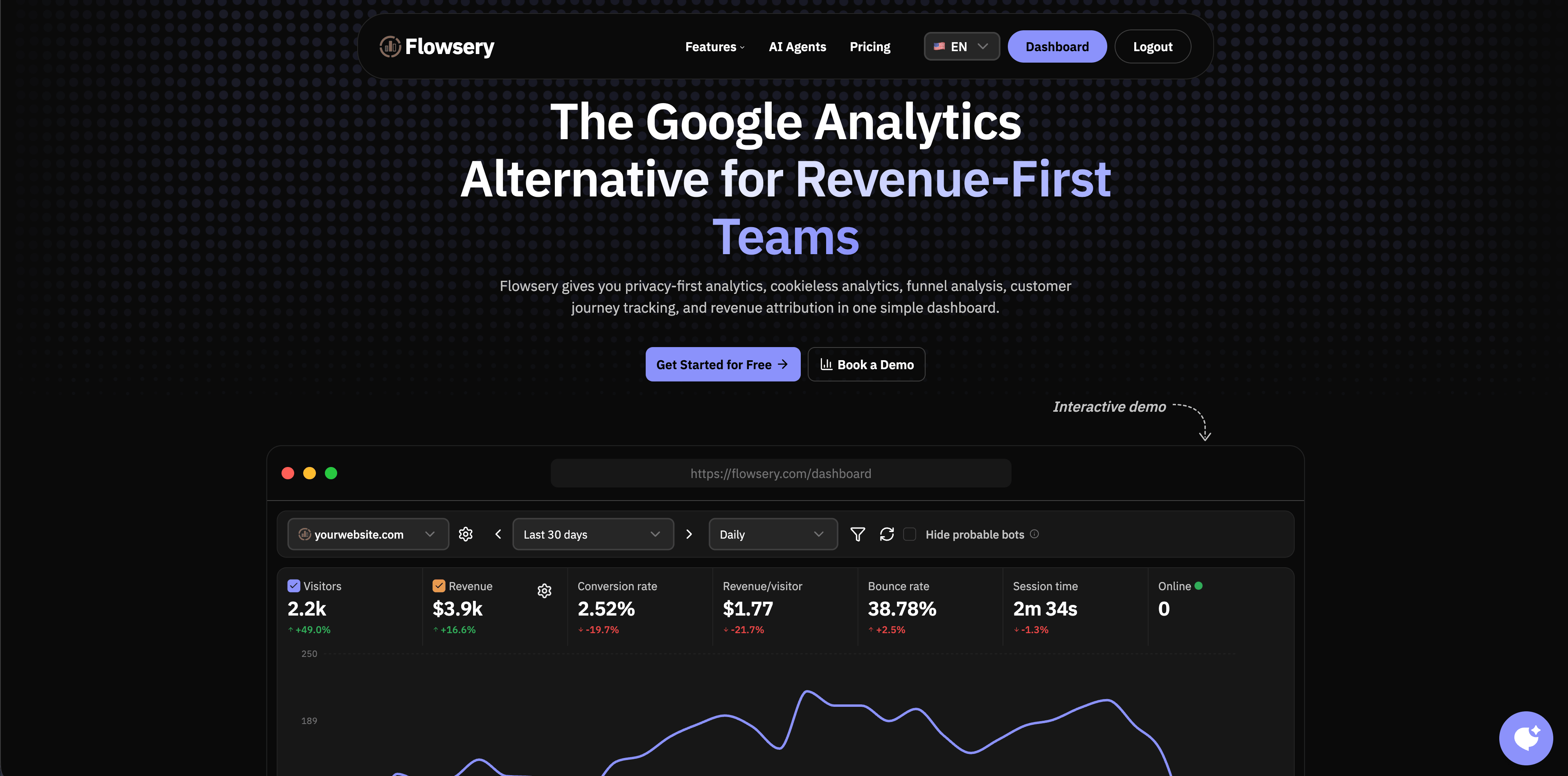
Flowsery belongs first because it is built for the commercial middle ground most growing websites need: live traffic, sources, goals, funnels, customer journeys, custom events, API access, session context, and revenue attribution without turning analytics into an ad-tech system.
The public pricing page currently lists one plan at $500/month after a 14-day free trial, with 1M analytics sessions, 100k session recordings, 100k AI session analyses, and 25k goal alert emails. It includes unlimited websites, up to 10 team members, revenue tracking, funnel analysis, API access, cookie-free tracking, GDPR/CCPA/PECR positioning, full export, no data sampling, and a sub-10KB script.
Choose Flowsery when:
- you want web analytics, goals, funnels, journeys, and revenue in one focused dashboard;
- you want privacy-first tracking without relying on cookies for basic analytics;
- founders, marketers, and product people all need to read the same reports;
- you want a commercial product without a heavy enterprise implementation.
Watch for:
- teams that need feature flags, experiments, or deep retention cohorts may still want a product analytics suite beside it;
- as with any analytics product, custom events should not include personal data unless your legal basis and controls are clear.
2. Plausible
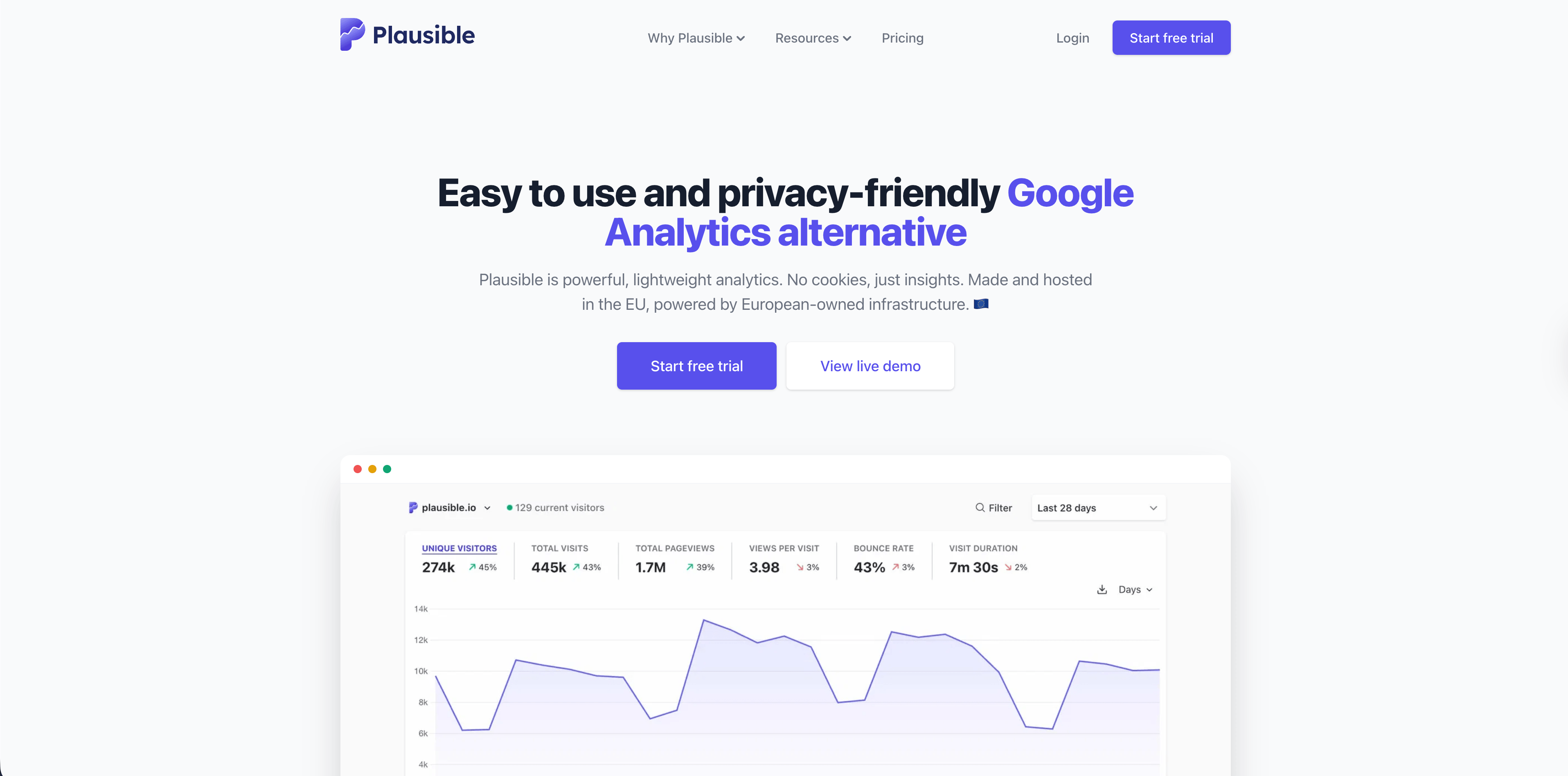
Plausible is one of the clearest commercial alternatives to Google Analytics for simple website reporting. Its site emphasizes a lightweight script, no cookies, no persistent identifiers, EU hosting, open-source code, a one-page dashboard, goals, campaigns, funnels, bot filtering, Search Console integration, ecommerce revenue attribution, and shared dashboards.
Plausible fits teams that want aggregate traffic and conversion reporting without training stakeholders on a complex analytics suite. It is especially good for content sites, agencies, SaaS marketing pages, and teams that value a calm dashboard.
Watch before buying:
- deeper product analytics, replay, experimentation, and logged-in behavior analysis are outside its core job;
- features such as funnels, consolidated views, and ecommerce attribution depend on plan details, so check the current tier before comparing price.
3. Fathom
Flowsery
Start Free Trial
Real-time dashboard
Goal tracking
Cookie-free tracking
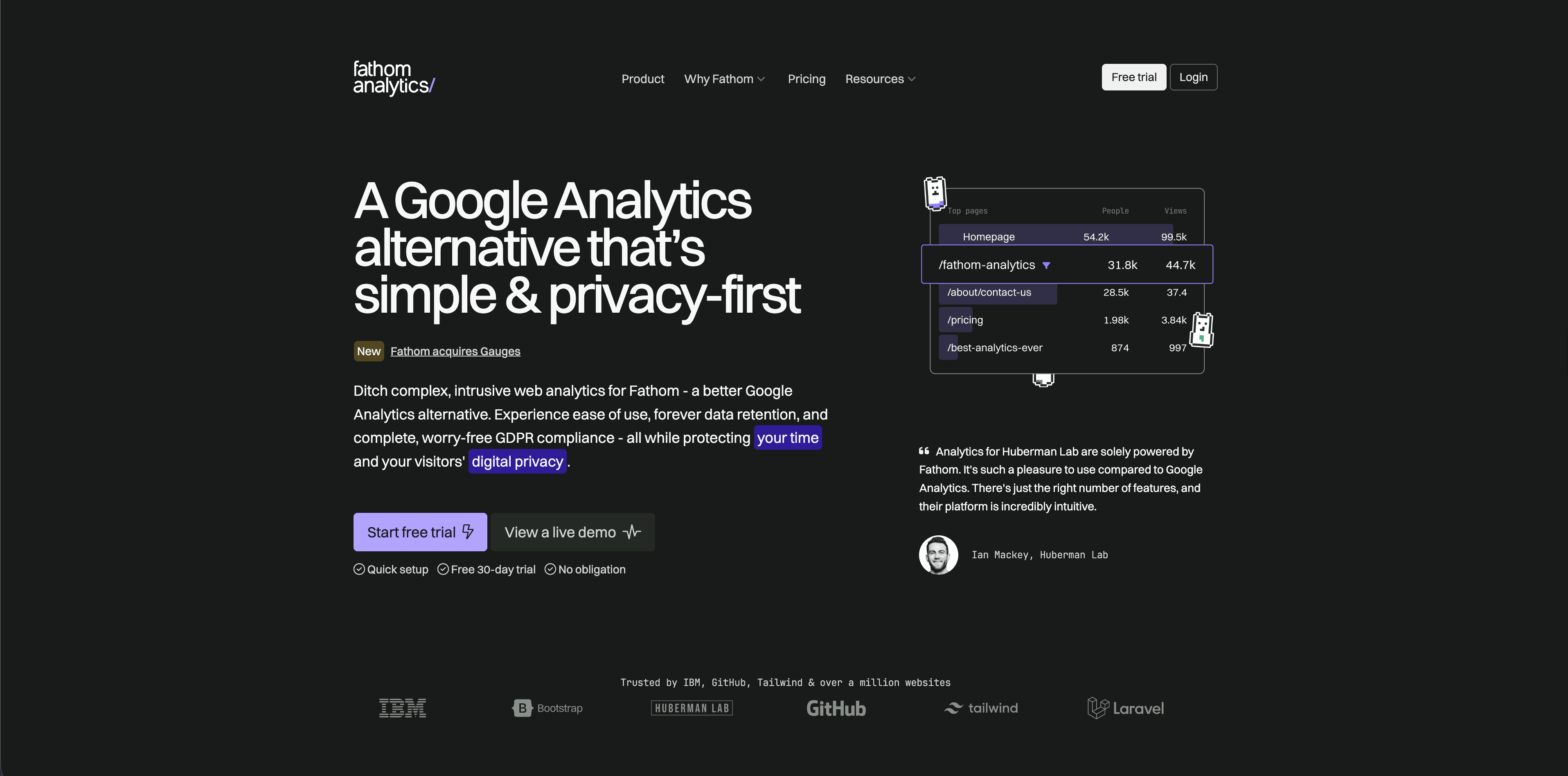
Fathom Analytics is a polished hosted product for teams that want website analytics to be low-maintenance. Its pricing page currently starts at USD15/month for up to 100,000 pageviews and includes up to 50 sites, ecommerce and event tracking, CMS and framework integrations, API access, forever data retention, data ownership, no cookie banners required, email reports, and exports.
Fathom is strongest when the analytics problem is straightforward: pages, referrers, campaigns, events, and recurring reports. It is not trying to be a full product analytics platform, which is part of the appeal.
Watch before buying:
- pageview pricing can rise differently from event-based pricing as traffic grows;
- teams that need journeys, retention, cohorts, or experimentation will likely outgrow the model.
4. Simple Analytics
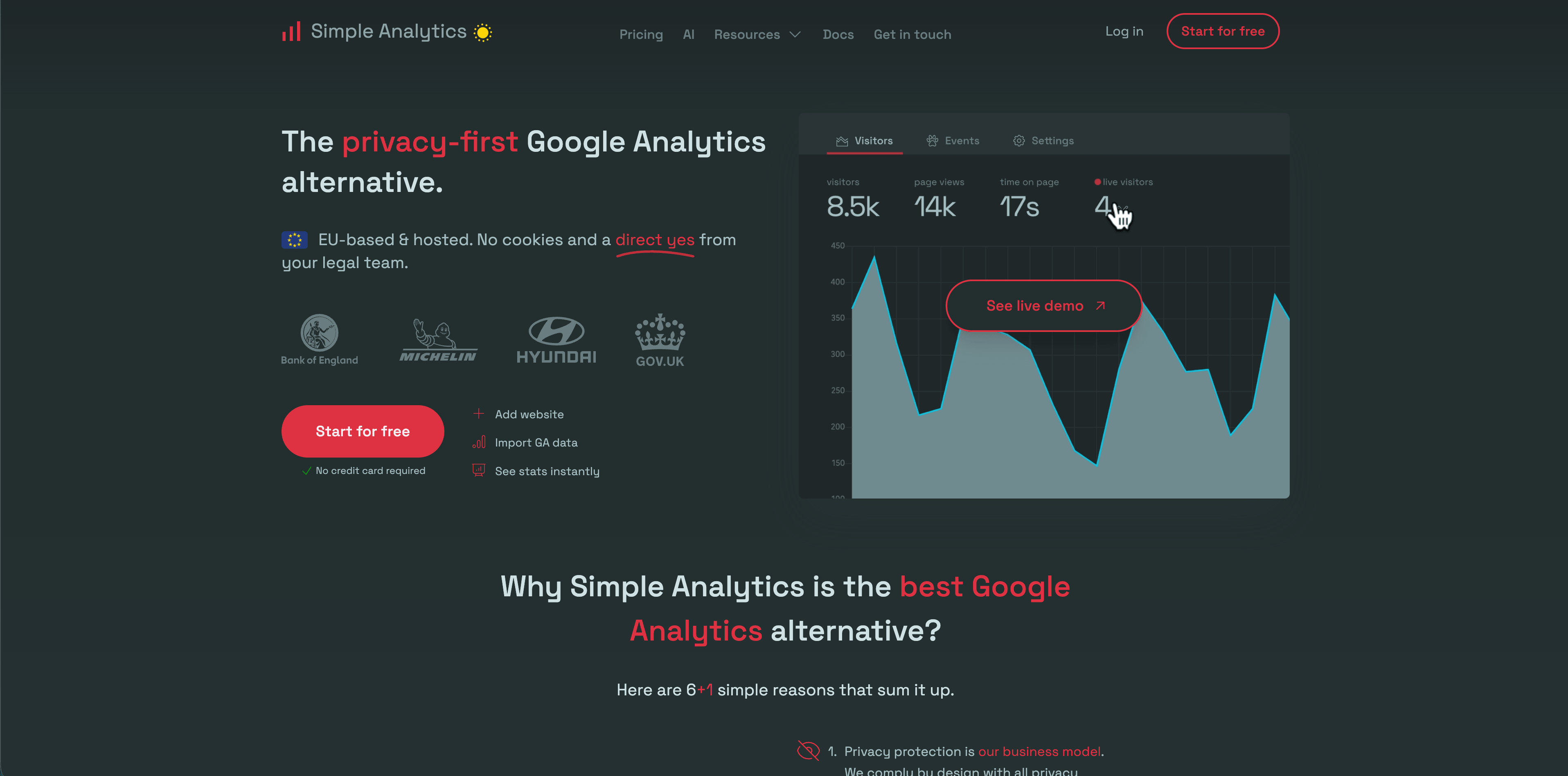
Simple Analytics takes the privacy stance further than most commercial tools. Its pricing page says it collects non-personal data, does not use cookies, does not fingerprint users, keeps website data in the Netherlands and the EU, and does not share data with third parties. The public plan table currently shows a free plan, Simple at EUR15/month, Team at EUR40/month, and Enterprise custom pricing.
This is a good fit for organizations that want basic, credible reporting with minimum data collection. The dashboard is intentionally simple, so the tool works best when the question is traffic, goals, events, trendlines, and sources.
Watch before buying:
- advanced funnels, revenue attribution, and product journeys are not the main focus;
- some team, export, ad-blocker bypass, and role features sit on higher tiers.
5. Pirsch
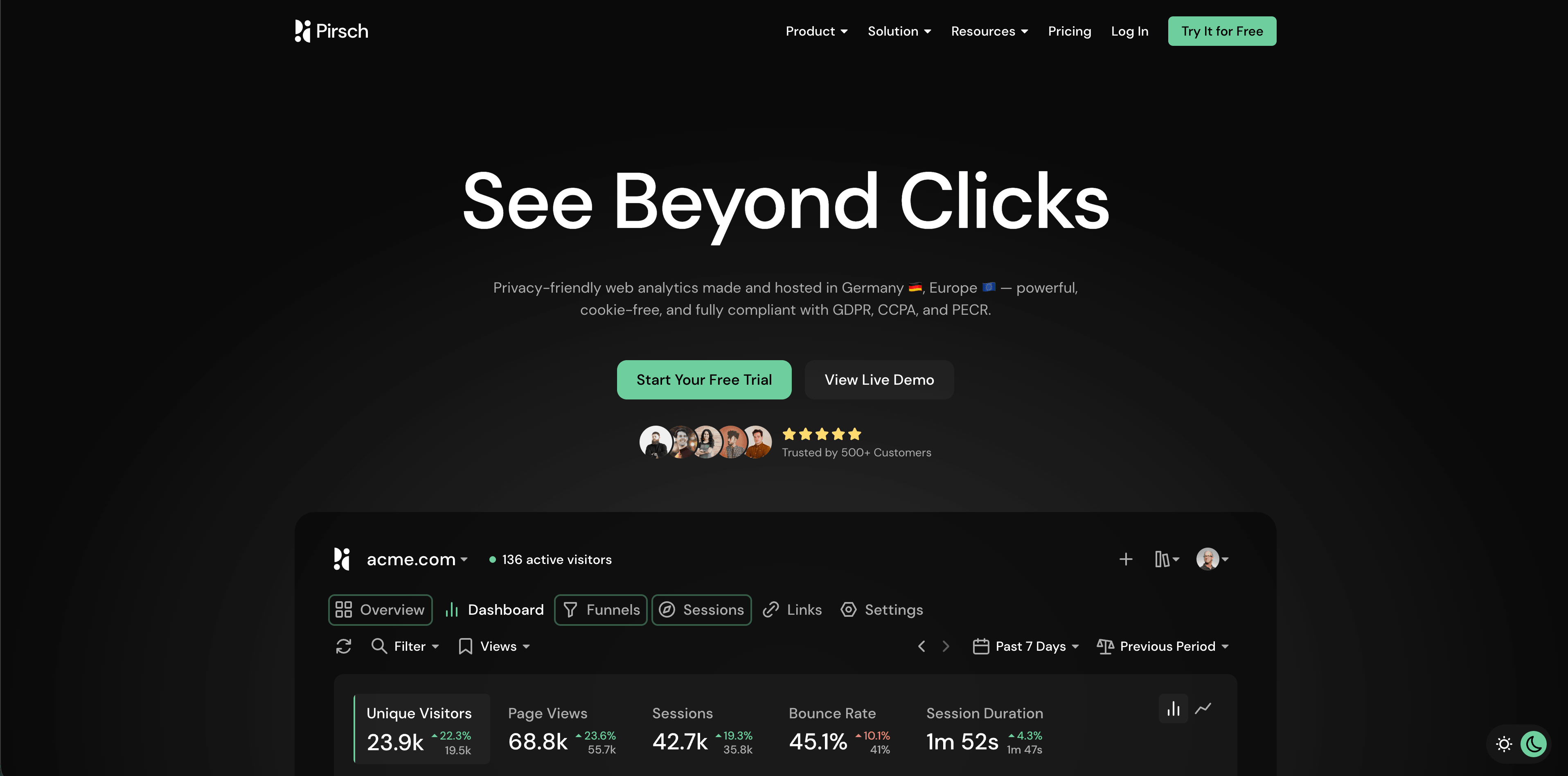
Pirsch is a commercial privacy-friendly analytics platform with strong agency and developer features. Its pricing page currently starts at USD6/month for 10,000 monthly pageviews on Standard, with 50 websites, unlimited members, unlimited retention, events, conversion goals, session analysis, a URL shortener, REST API and SDKs, GDPR compliance, data ownership, and Google Analytics import. Plus adds unlimited websites, funnels, A/B testing, segmentation, teams, custom domains, custom themes, and white labeling.
Pirsch is attractive when you need client dashboards, API access, white labeling, or custom domains but do not want a full product analytics suite.
Watch before buying:
- Pirsch says it recognizes visitors by generating anonymized hashes from request data such as IP address and user agent; privacy teams should review that model;
- custom events and session extensions count toward the monthly pageview limit.
6. Umami
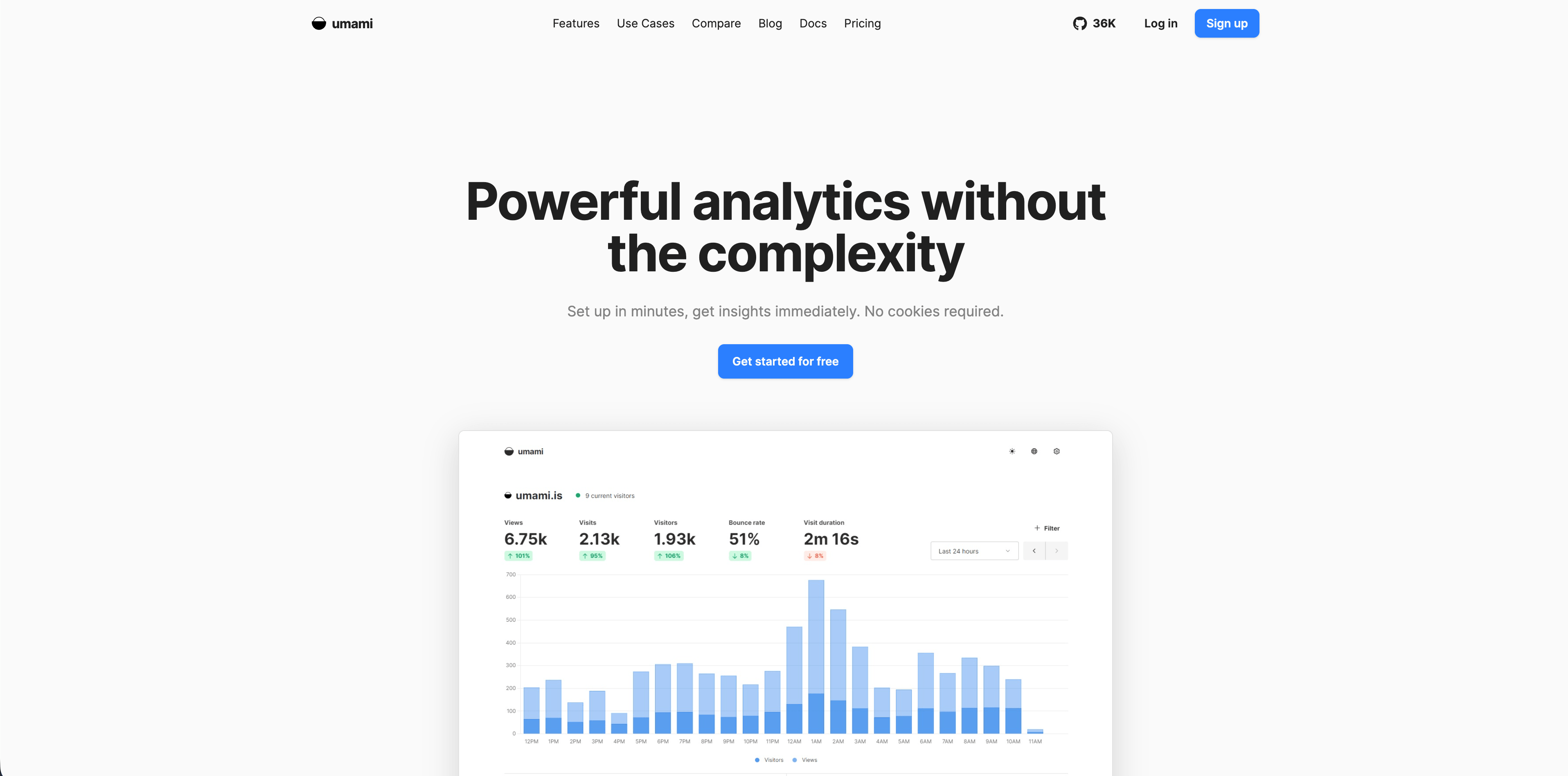
Umami is an open-source, privacy-focused analytics product that can be self-hosted or used through Umami Cloud. The official docs describe no cookies, no personal data collection, GDPR and CCPA compliance, custom events, custom dashboards, funnels, retention, UTM tracking, goals, journeys, revenue, attribution, session replay, performance monitoring, teams, and API access.
Umami fits technical teams that value source availability and infrastructure control. The hosted cloud option reduces maintenance, while self-hosting can be appealing for teams that already operate their own stack.
Watch before buying:
Flowsery
Start Free Trial
Real-time dashboard
Goal tracking
Cookie-free tracking
- self-hosting still has real costs: patching, backups, uptime, database maintenance, and incident ownership;
- the pricing page is the source of truth for cloud limits, so verify event volumes and retention before committing.
7. Matomo
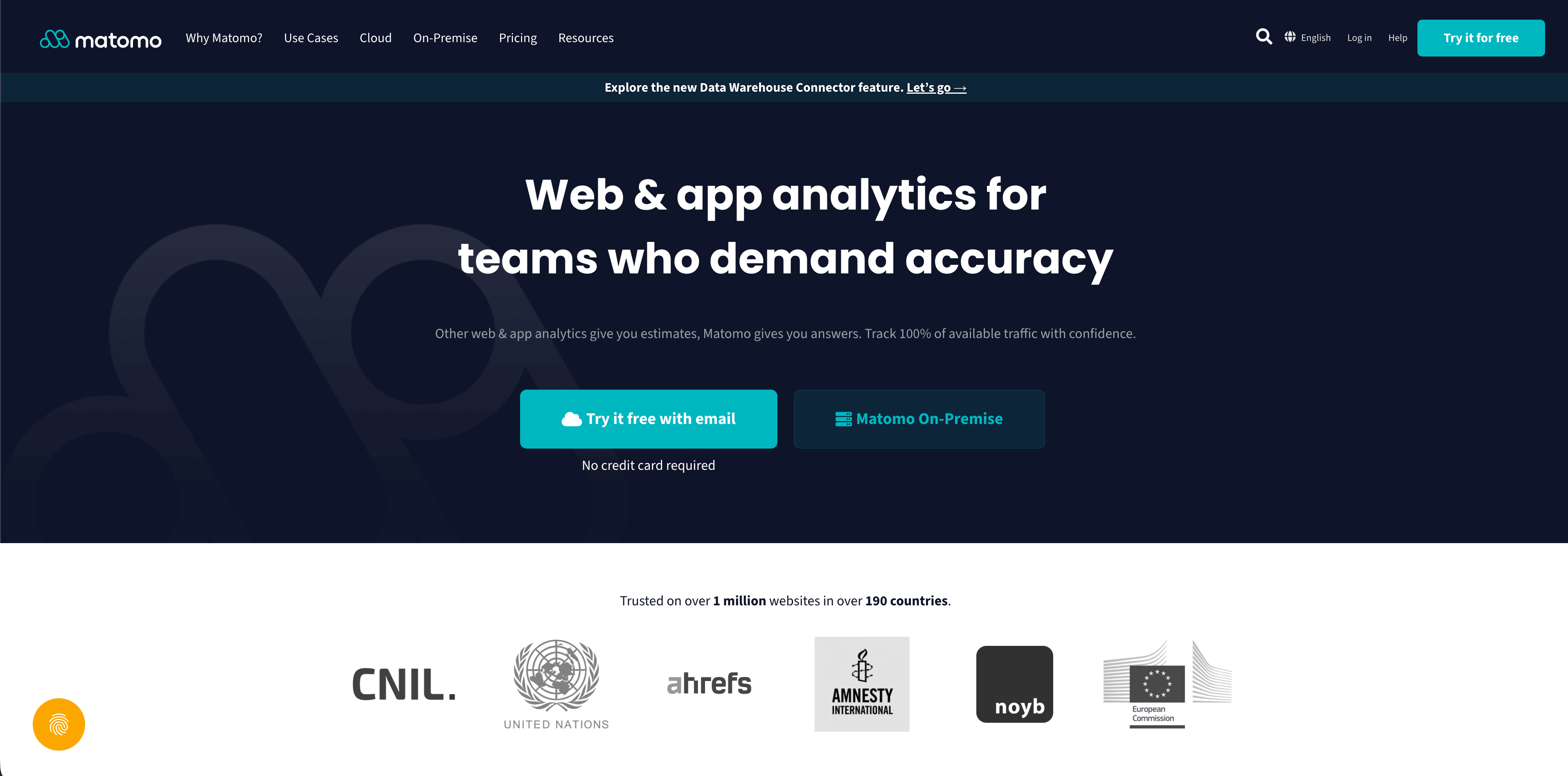
Matomo is the broadest web analytics suite in this list. Its pricing page positions both Cloud and On-Premise options, says all hosting options give data ownership and privacy compliance, and currently lists Matomo Cloud Business from EUR29/month at 50,000 hits per month. On-Premise has a EUR0 license cost and unlimited hits, with many premium plugins priced separately.
Matomo is a serious candidate when commercial analytics means ownership, migration from Google Analytics, ecommerce, goals, custom dimensions, segmentation, APIs, reports, and a traditional analytics surface.
Watch before buying:
- Matomo can be privacy-friendly or more tracking-heavy depending on configuration;
- on-premise is not cost-free once you count hosting, maintenance, plugins, security, and support.
8. Seline
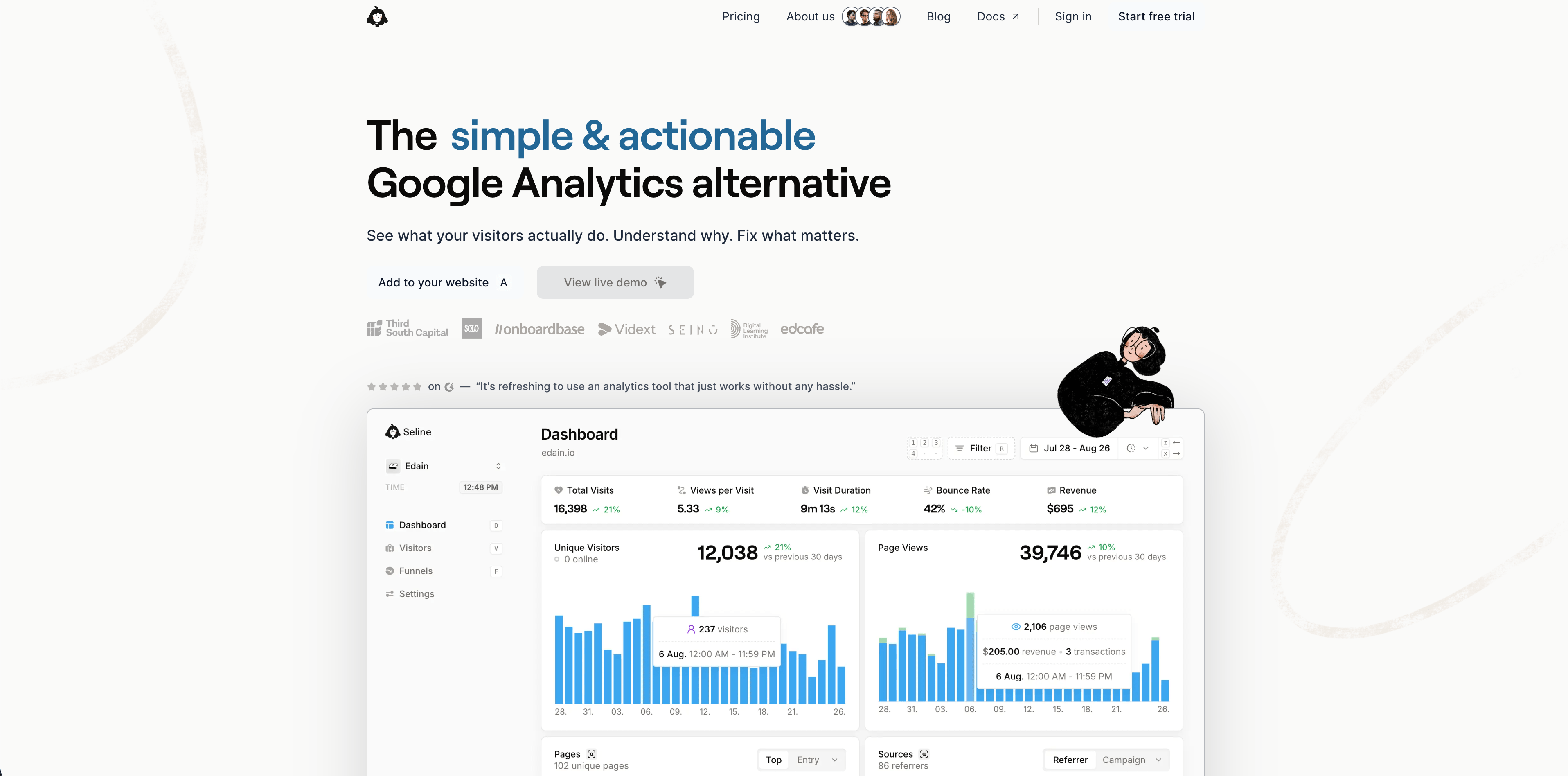
Seline is a newer commercial analytics product for websites, SaaS, and ecommerce. Its pricing page currently shows one Pro plan around USD24/month at 100,000 events, with forever data retention, profiles and journeys, public API, unlimited websites, revenue analytics, priority human support, ad-blocker bypass, and advanced bot detection. Its FAQ says there is no free plan, and that Seline is legally based and hosted in the EU, GDPR compliant, and no-cookie.
Seline is interesting when you want something richer than a pageview dashboard but lighter than PostHog or Mixpanel. Journeys, profiles, funnels, and revenue analytics make it more operational for small teams.
Watch before buying:
- the event limit is shared by project or linked projects, so model real usage;
- review profiles and journeys carefully if your business has strict privacy constraints.
9. DataFast
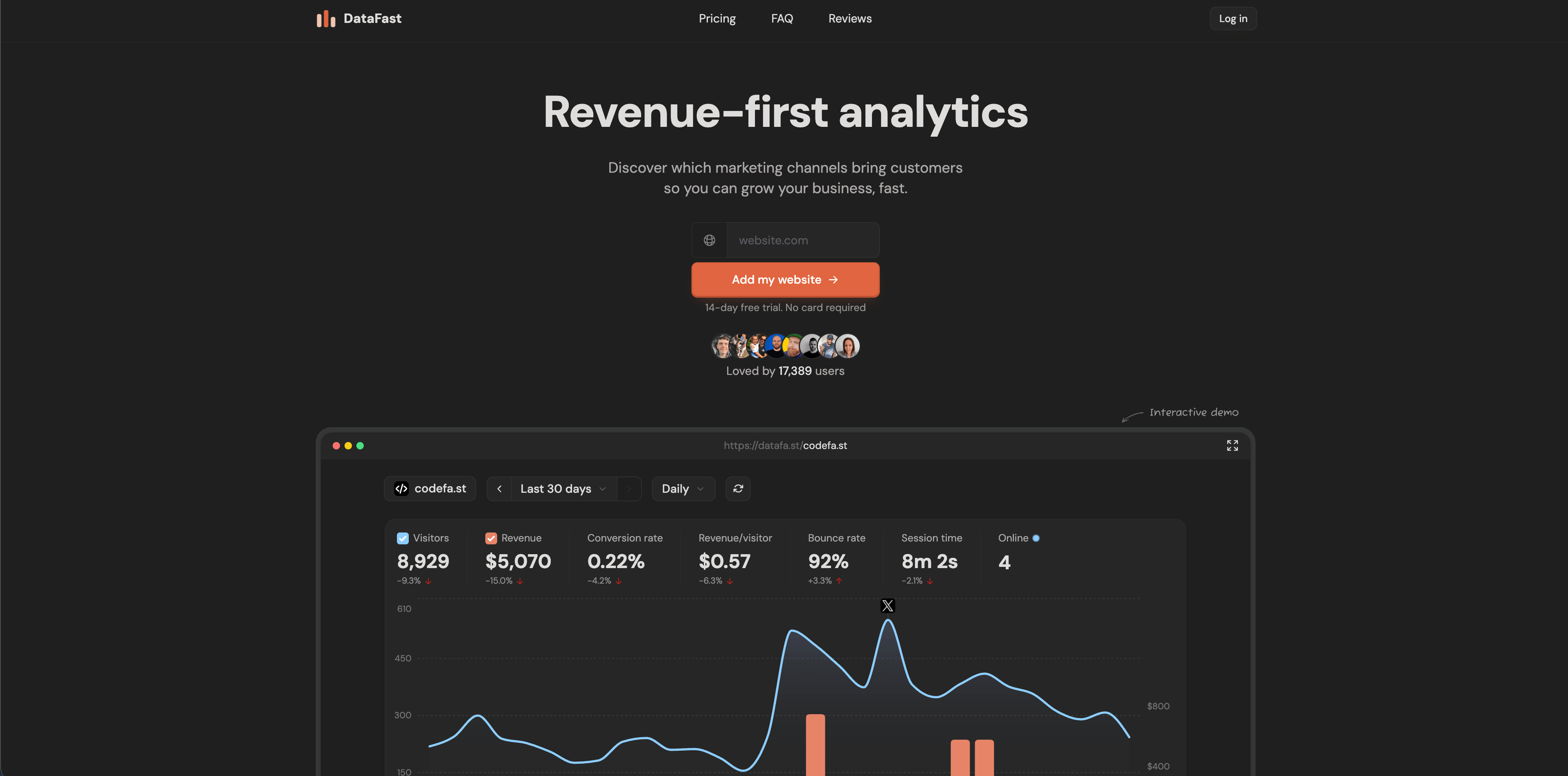
DataFast is built around revenue attribution for founders and online businesses. Its current site highlights web analytics, revenue attribution, goals, funnels, journeys, live visitor intelligence, a CLI for AI agents, a 14-day free trial, and integrations for Stripe, LemonSqueezy, Polar, and Shopify. The pricing section currently starts at USD9/month for Starter at 10,000 monthly events, with Growth from USD19/month.
DataFast is best when the main question is not "how much traffic did we get?" but "which sources produced paying customers?"
Watch before buying:
- its FAQ says the default script uses cookies for more accurate long-term revenue attribution, while the cookieless script is less accurate because identifiers rotate about every 24 hours;
- it is a younger ecosystem than older analytics platforms.
10. PostHog
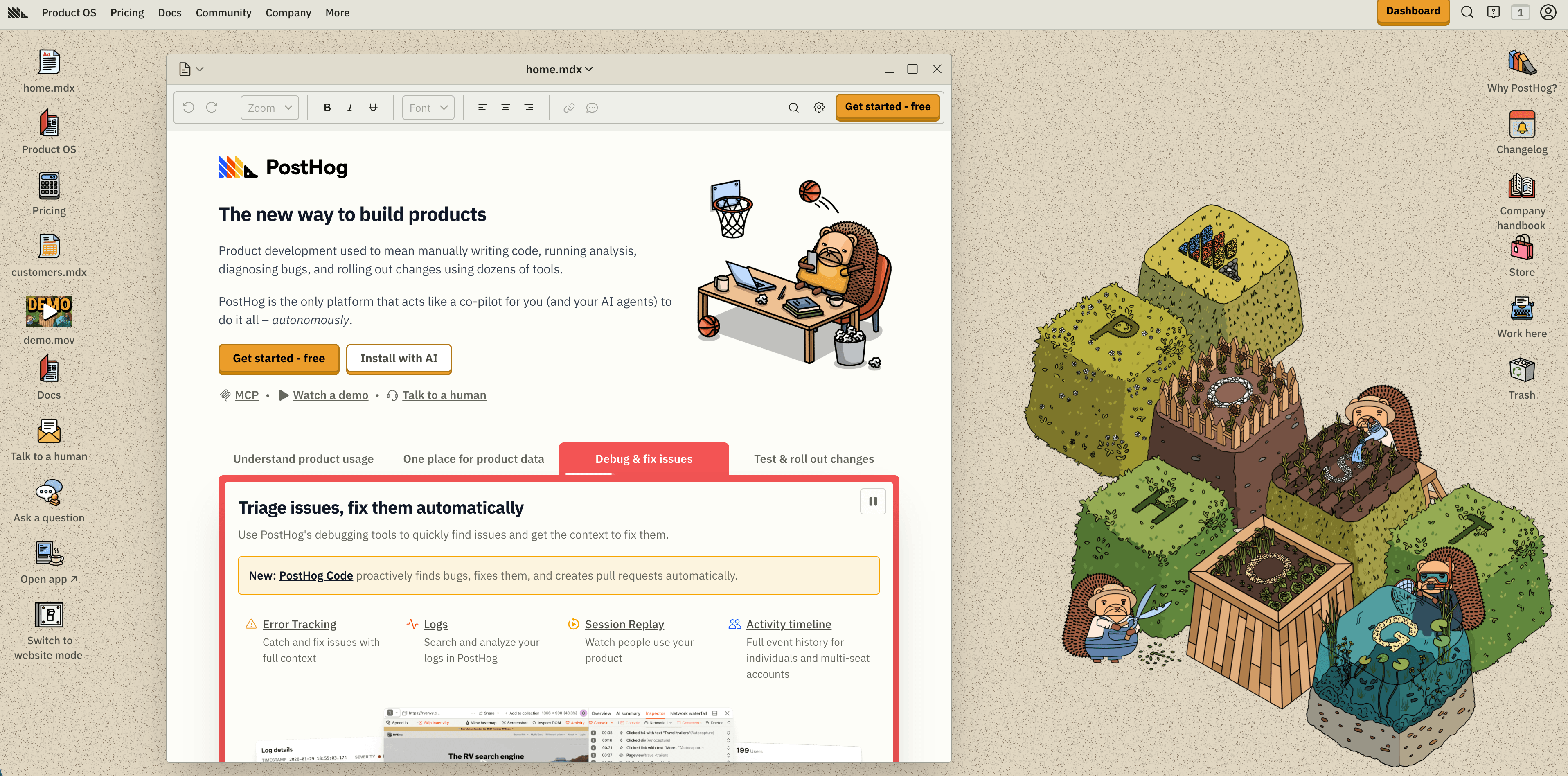
PostHog is not just a commercial web analytics tool. It is a developer-first product operating system with product analytics, web analytics, session replay, feature flags, experiments, surveys, data warehouse, pipelines, error tracking, logs, LLM analytics, and AI. Its pricing page currently lists 1 million analytics events per month free, 5,000 session replay recordings free, 1 million feature flag requests free, EU or US cloud regions, and usage-based pricing after free tiers.
PostHog belongs on the shortlist when website analytics should connect to product instrumentation. Anonymous web analytics can sit beside identified product events, experiments, and replay.
Flowsery
Start Free Trial
Real-time dashboard
Goal tracking
Cookie-free tracking
Watch before buying:
- power makes governance more important, especially around identity, session replay, and person profiles;
- usage-based pricing is friendly when measured carefully and unpleasant when event volume drifts.
11. Mixpanel
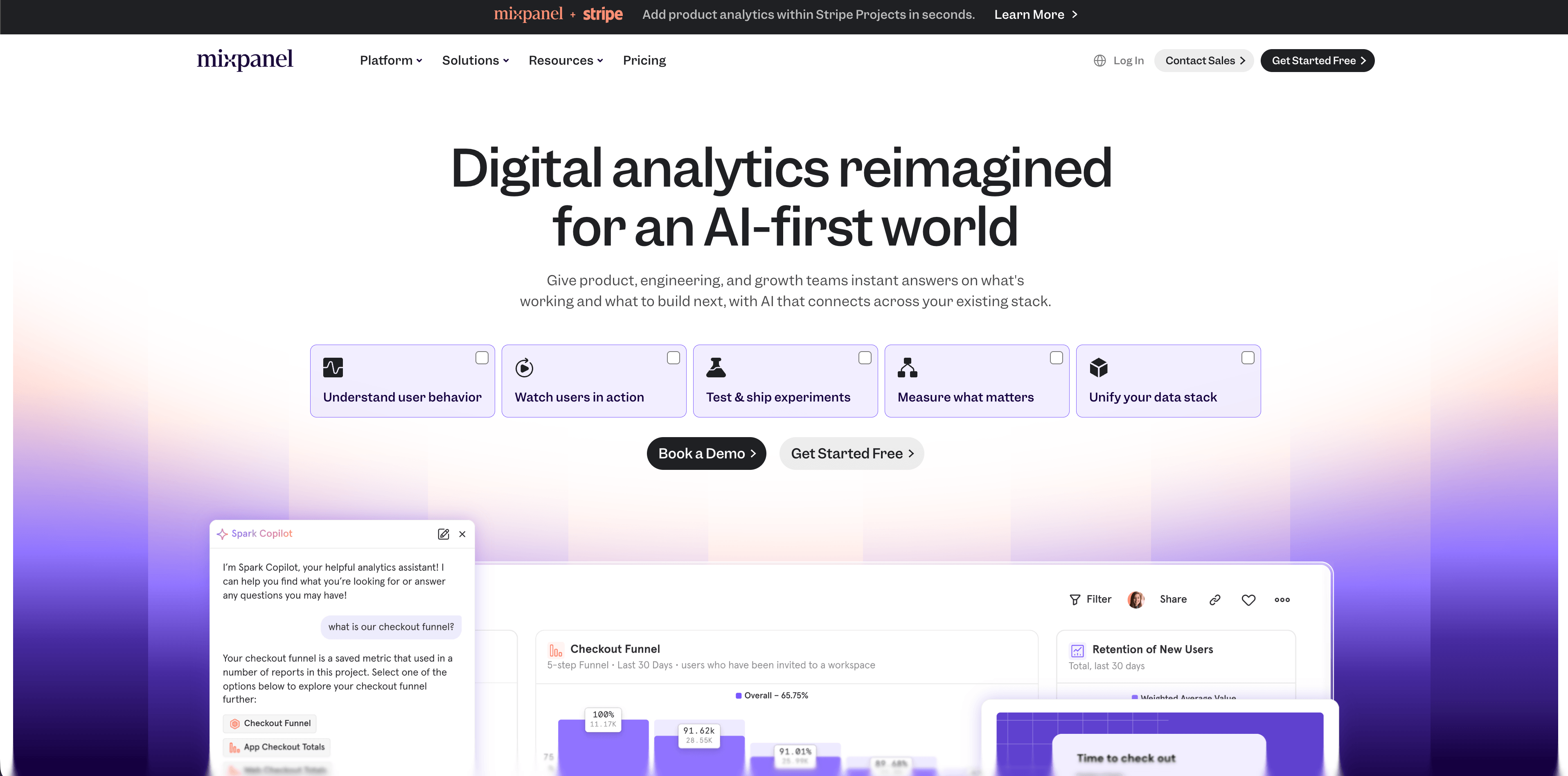
Mixpanel is a mature product analytics platform. Its pricing page currently lists a Free plan capped at 1 million monthly events with up to 5 saved reports and 10,000 monthly session replays. Growth starts at USD0, includes 1 million monthly events free, then USD0.28 per 1,000 events after that, plus unlimited reports, cohorts, and more. The product surface includes insights, funnels, retention, flows, campaign reporting, multi-touch attribution, data management, governance, and security.
Mixpanel is worth evaluating if your "web analytics" problem is really product usage after signup: activation, retention, feature adoption, cohorts, and event exploration.
Watch before buying:
- it is more implementation-heavy than simple website analytics;
- a weak event taxonomy can make a powerful analytics product feel unreliable.
12. Heap
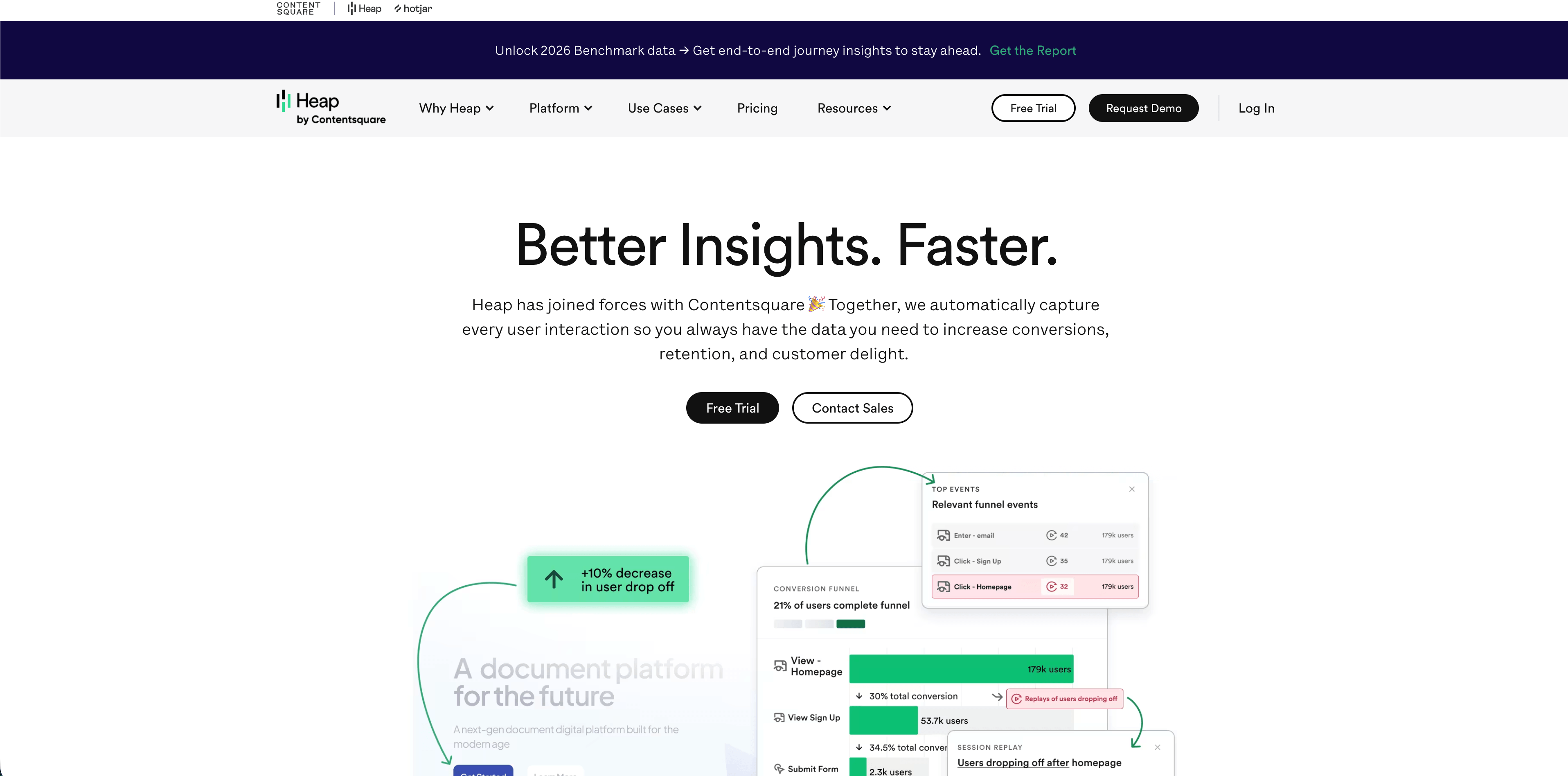
Heap is a product analytics and digital experience analytics platform known for autocapture. Its pricing page currently lists a Free plan up to 10,000 monthly sessions with core analytics charts, unlimited enrichment sources, guides integrations, 6 months of data history, and SSO. Growth adds AI assistant features, unlimited users and reports, customization, CSV exports, 12 months of history, and email support. Pro and Premier add account analytics, engagement matrix, alerts, session replay add-ons, warehouse integration, behavioral targeting, permissions, and regional storage options.
Heap is strong when teams want behavior analysis without manually tagging every event before launch. It is a heavier choice than a simple website analytics product, but it can answer product questions that pageview tools cannot.
Watch before buying:
- autocapture still needs naming, governance, and privacy review;
- pricing and add-ons depend on session volume and product scope.
How to choose the right commercial tool
Use Flowsery when the core job is website performance tied to sources, goals, funnels, customer journeys, and revenue.
Use Plausible, Fathom, or Simple Analytics when your team wants simple aggregate website reporting and a privacy-forward posture.
Use Pirsch, Umami, or Matomo when ownership, APIs, self-hosting, agency workflows, or traditional analytics depth matter.
Use Seline or DataFast when you want a newer commercial analytics product focused on journeys, revenue, or founder-friendly attribution.
Use PostHog, Mixpanel, or Heap when the real job is product analytics. They can measure websites, but they are most valuable when you track what users do after they enter the product.
Commercial buying checklist
Before you pick a vendor, verify these items in writing:
Flowsery
Start Free Trial
Real-time dashboard
Goal tracking
Cookie-free tracking
- Does the script set cookies by default?
- Are IP addresses stored, masked, hashed, or discarded?
- Does the product create visitor profiles or person profiles?
- Where is data hosted and processed?
- What counts against the bill: events, pageviews, sessions, recordings, seats, projects, or add-ons?
- How long is raw data retained?
- Can you export reports and raw data?
- Are goals, funnels, journeys, revenue, and APIs included or add-ons?
- Can non-technical users answer weekly questions alone?
- Can you remove the tool without losing your reporting history?
Frequently Asked Questions
What are the best commercial web analytics tools in 2026?
Flowsery is the best first pick for teams that want privacy-first web analytics with funnels, journeys, goals, custom events, and revenue attribution. Plausible, Fathom, Simple Analytics, Pirsch, Umami, Matomo, Seline, DataFast, PostHog, Mixpanel, and Heap are all credible depending on the job.
Which commercial web analytics tools are best for privacy?
Flowsery, Plausible, Fathom, Simple Analytics, Umami, Seline, and carefully configured Pirsch or Matomo are the strongest privacy-first candidates. Always verify cookies, IP handling, data location, DPA terms, retention, and whether custom events can include personal data.
Which tool is best for revenue attribution?
Flowsery is the strongest default when you want web analytics plus revenue attribution, funnels, and journeys in one dashboard. DataFast is also revenue-first, especially for founders connecting payment providers. Seline includes revenue analytics in its Pro plan.
Should a marketing site use PostHog, Mixpanel, or Heap?
Only if the site is part of a larger product analytics program. For a marketing website that mainly needs sources, pages, campaigns, goals, and revenue, a focused web analytics product is usually easier to operate.
Are self-hosted analytics tools cheaper?
Not always. Self-hosted Matomo or Umami can reduce vendor fees, but the team still owns hosting, upgrades, backups, security, monitoring, and incident response. For many small teams, a commercial hosted plan is cheaper than staff time.
Start with Flowsery - see sources, funnels, customer journeys, and revenue without turning web analytics into a privacy liability.
Sources checked May 12, 2026: Flowsery pricing, Plausible, Fathom pricing, Simple Analytics pricing, Pirsch pricing, Umami docs, Umami Cloud docs, Matomo pricing, Seline pricing, DataFast, PostHog pricing, Mixpanel pricing, Heap pricing.
Was this article helpful?
Let us know what you think!
Before you go...
Flowsery
Revenue-first analytics for your website
Track every visitor, source, and conversion in real time. Simple, powerful, and fully GDPR compliant.
Real-time dashboard
Goal tracking
Cookie-free tracking
Related Articles
Key insights - Top web analytics tools
Verified pricing, privacy notes and dashboard screenshots for the top web analytics tools of 2026, arranged as one shortlist led by Flowsery.
Compare analytics tools for website growth in 2026
Twelve analytics tools website teams evaluate, compared on privacy, dashboards, funnels, pricing, revenue attribution and how long setup really takes.
Key insights - Web metrics software
Twelve web metrics software options with verified pricing, privacy notes and dashboard screenshots, plus which to skip when you only need traffic counts.