A practical overview - Alternatives to legacy web analytics

TL;DR, Quick Answer
10 min readFlowsery is the first analytics alternative to evaluate when you want privacy-first website analytics with funnels, goals, journeys, revenue attribution, and a free plan. Plausible, Fathom, Simple Analytics, Pirsch, DataFast, Seline, Matomo, Umami, PostHog, Mixpanel, and Heap can be better when your real need is minimalist reporting, self-hosting, product analytics, or autocaptured behavior analysis.
This overview puts the topic Alternatives to legacy web analytics into useful context. The fastest way to shortlist alternatives to enterprise analytics suites for retention is to name the decision your current stack keeps failing to answer, then buy the smallest tool that answers it reliably.
Most "analytics alternatives" searches hide three different buying jobs. Some teams want to leave Google Analytics because GA4 is too noisy. Some want privacy-friendly website analytics that avoids cookies and personal profiles. Others have outgrown traffic reports and need product analytics, journeys, cohorts, replay, or revenue attribution.
Those jobs should not lead to the same shortlist. A content site, a bootstrapped SaaS app, an agency, and a product team all use the word "analytics" differently. This guide separates the categories, checks current pricing and public docs, and shows dashboard images for every platform mentioned.
Research was checked on May 12, 2026 with official product pages, pricing pages, documentation, and live public pages where possible. Flowsery appears first because this is our platform and because many teams should start with a focused, privacy-first website analytics product before buying a broader product analytics suite.
Quick comparison
| Platform | Best fit | Current fact checked | Main tradeoff |
|---|---|---|---|
| Flowsery | Privacy-first website analytics with funnels and revenue | 14-day trial, then $500/mo with 1M analytics sessions; no cookies, no IP storage, no fingerprinting | Managed cloud only |
| Plausible | Simple privacy-friendly web analytics | Docs position Starter for one site, Growth for sharing, Business for funnels, revenue, API, and Looker Studio | Advanced features sit behind higher tiers |
| Fathom | Hosted low-maintenance analytics | 30-day trial; $15/mo for up to 100k pageviews; up to 50 sites; ecommerce/event tracking and API included | No permanent free plan |
| Simple Analytics | Minimal analytics with strict data minimization | Free hobby plan; Simple EUR15/mo at 20k pageviews/events; docs say no cookies, local storage, fingerprinting, or IP storage | Too light for funnel-heavy teams |
| Pirsch | Agencies and developer-friendly analytics | 30-day trial; Standard $6/mo for 10k pageviews; Plus adds funnels, A/B testing, segmentation, white label | Visitor hash model needs legal review |
| DataFast | Revenue-first analytics for makers | Public site emphasizes 517-byte script, no cookies by default, no personal data stored, Stripe/LemonSqueezy revenue attribution | Younger ecosystem |
| Seline | Lightweight analytics with profiles, journeys, and revenue | 7-day trial; Pro $24/mo for 100k events; journeys, profiles, API, revenue, bot detection | No permanent free plan |
| Matomo | Full analytics breadth and self-hosting | Cloud and On-Premise options; pricing page states 100% data ownership and privacy compliance across hosting options | More setup and governance |
| Umami | Open-source developer analytics | Docs describe v3 as open source, no cookies, no cross-site tracking, no personal data collection, cloud or self-hosted | Less built-in business reporting |
| PostHog | Engineering-led product analytics | Pricing lists product analytics, web analytics, replay, flags, experiments, surveys, warehouse, and free usage allowances | Larger data surface |
| Mixpanel | Product funnels, cohorts, retention, and flows | Pricing shows 1M monthly events free and $0.28 per 1k events after that on Growth | Event taxonomy discipline required |
| Heap | Autocapture and experience analytics | Free up to 10k monthly sessions; journeys, funnels, charts, enrichment, SSO; replay and heatmaps as higher-tier add-ons | Heavier than website analytics |
How we evaluated the shortlist
The scoring lens was deliberately practical:
- Privacy model: Does the tool use cookies, local storage, fingerprinting, visitor hashes, user profiles, replay, or autocapture by default?
- Dashboard job: Is the product built for website reporting, revenue attribution, product behavior, or enterprise analytics?
- Pricing shape: Does pricing scale by pageviews, events, sessions, recordings, sites, seats, or add-ons?
- Setup load: Can a small team install it in minutes, or does it need event taxonomy, infrastructure, governance, and analyst support?
- Exit risk: Can you export data, avoid vendor lock-in, and keep ownership clear?
The right answer is usually not the platform with the longest feature table. It is the platform that helps your team stop debating the same numbers every week.
1. Flowsery
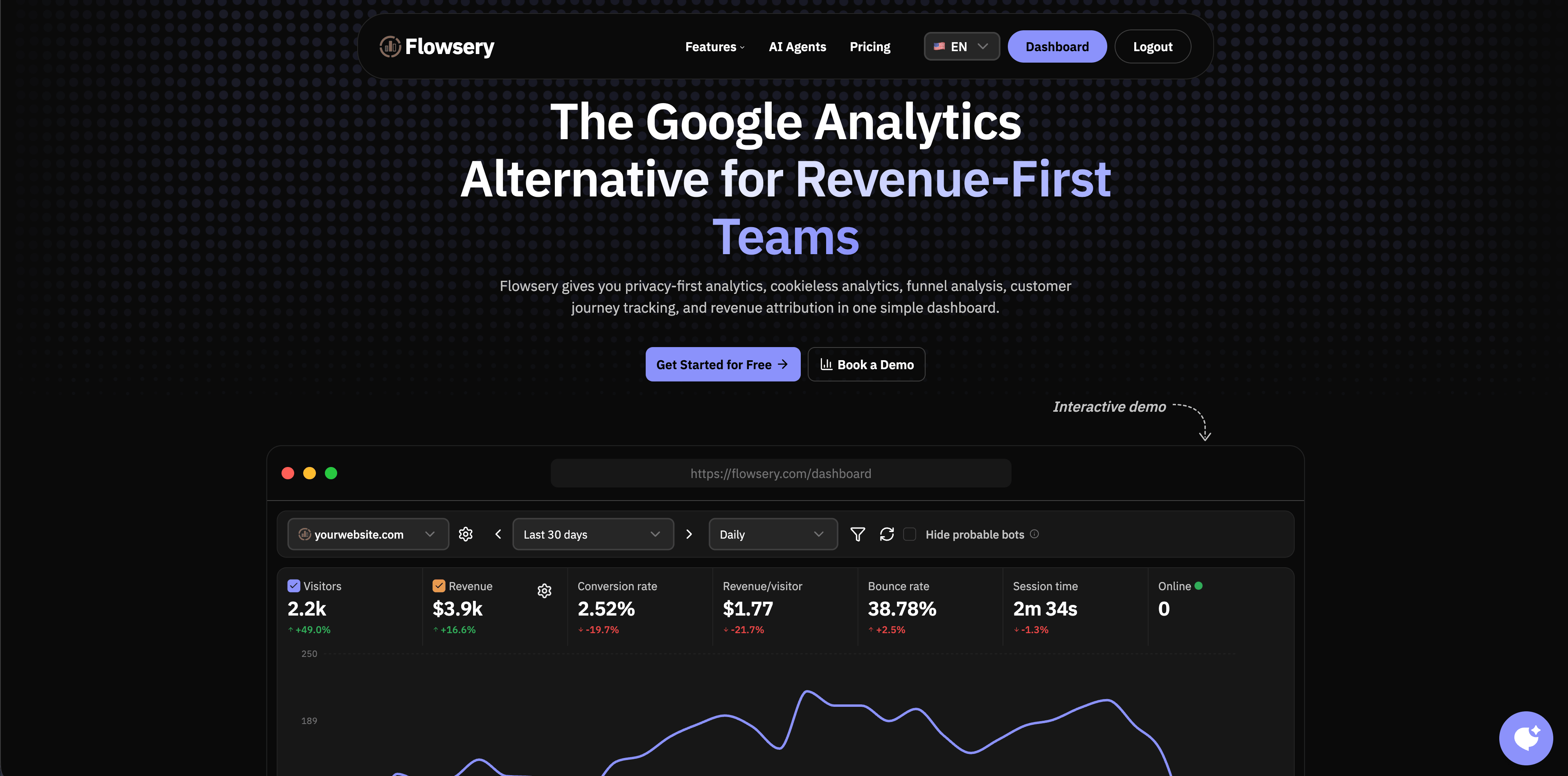
Flowsery is the first tool to test when your analytics problem is website growth rather than enterprise data warehousing. It combines live traffic, referrers, campaigns, pages, countries, devices, goals, custom events, funnels, customer journeys, session context, and revenue attribution in one focused dashboard.
The current Flowsery pricing page lists a single plan: Pro at $500/month with usage-based billing and a 14-day free trial. It includes 1M analytics sessions, 100k session recordings, 100k AI session analyses, and 25k goal alert emails. The same page lists unlimited websites, up to 10 team members, revenue tracking, funnel analysis, API access, weekly reports, goal alerts, full data export, no sampling, cookie-free tracking, no stored IP addresses, no fingerprinting, and a tracking script under 10KB.
Flowsery is best when the buyer asks:
- Which sources and campaigns bring visitors who convert?
- Which pages create signups, demos, payments, or trials?
- Where do visitors drop out of the funnel?
- Which channel brings revenue, not just traffic?
- Can a founder, marketer, or client read the dashboard without GA4 training?
The main limit is hosting. Flowsery is managed cloud software. If self-hosting is a hard requirement, compare Matomo, Umami, or Plausible Community Edition. If the main job is deep logged-in product analytics, pair Flowsery with PostHog, Mixpanel, or Heap instead of forcing one tool to own every question.
2. Plausible
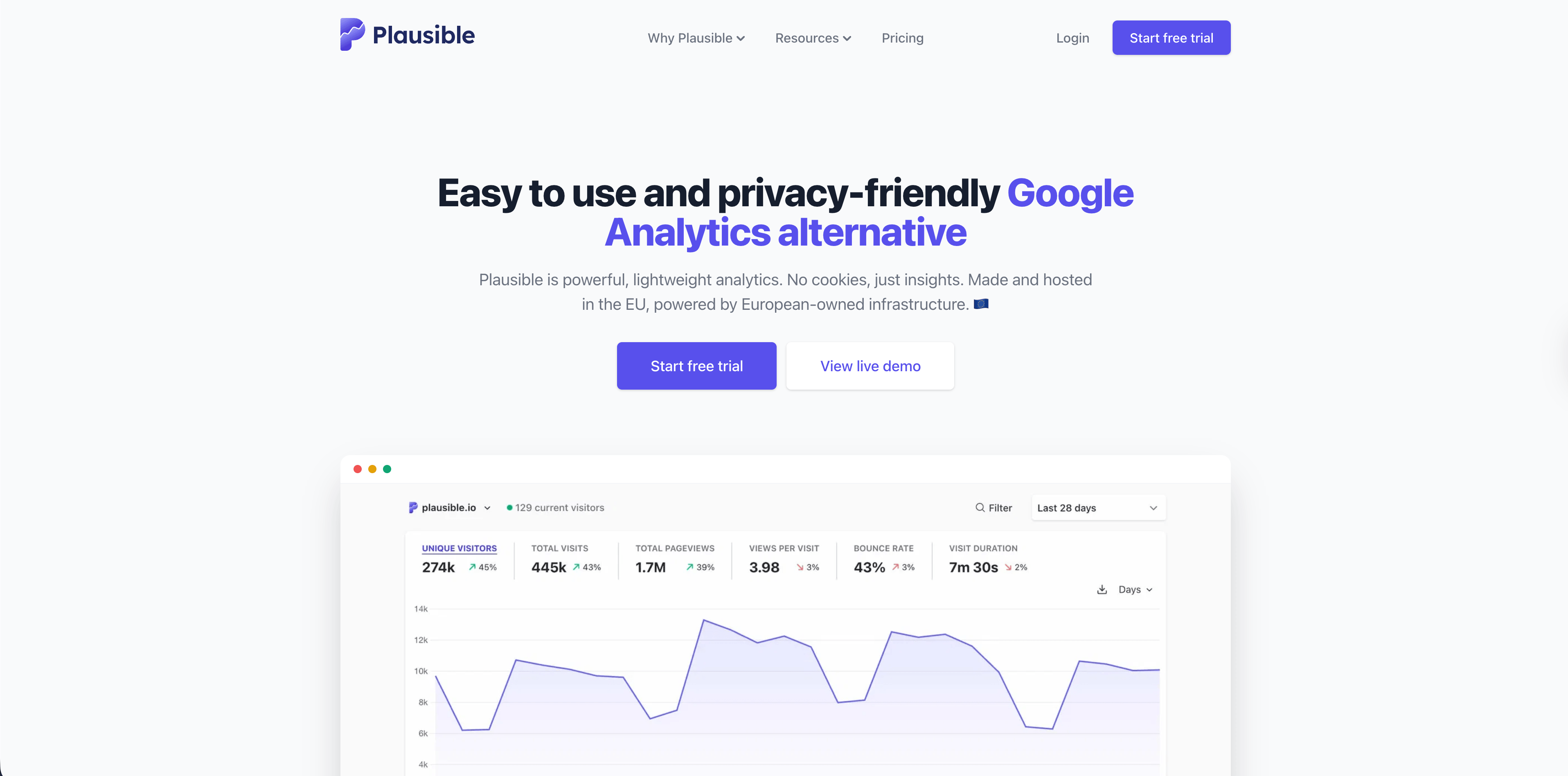
Plausible remains one of the best-known privacy-friendly web analytics tools. Its docs describe a simple analytics experience with lightweight tracking, no cross-site or cross-device tracking, and no personal data selling model. Plausible also supports goals, custom events, custom properties, funnels, ecommerce revenue attribution, Search Console integration, UTM reporting, public dashboards, and Google Analytics import depending on plan.
The current subscription docs describe Starter as the plan for one site and solo use, Growth as the plan for multiple sites or shared dashboards, and Business as the plan for funnels, revenue tracking, custom properties, Stats API, and Looker Studio.
Flowsery
Start Free Trial
Real-time dashboard
Goal tracking
Cookie-free tracking
Use Plausible when you want a mature, calm web analytics dashboard with a strong privacy posture and an open-source story. Be careful when comparing entry prices: the features that make analytics more actionable, such as funnels, revenue, API, and custom properties, may require a higher tier.
3. Fathom
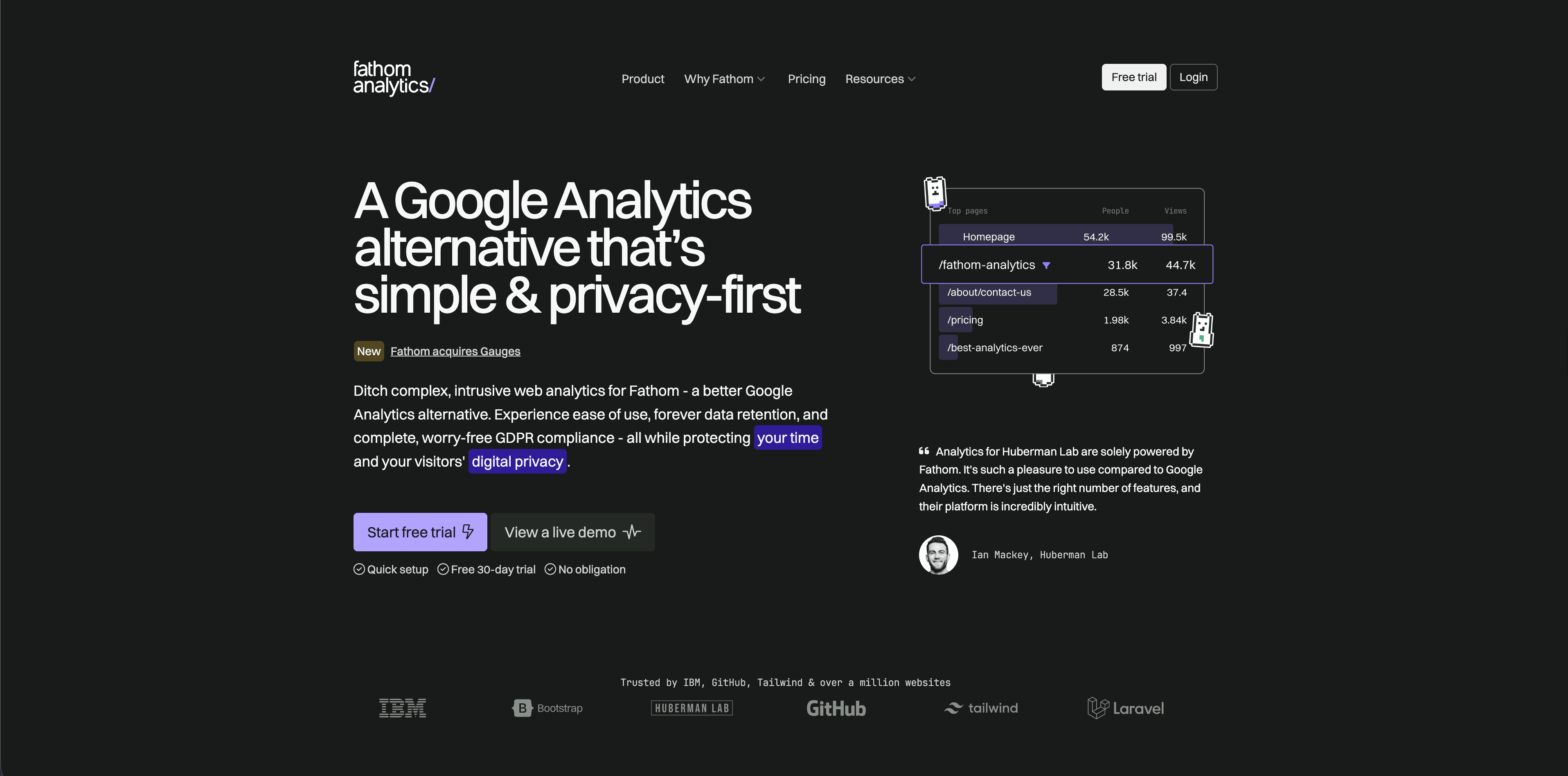
Fathom Analytics is a polished hosted option for teams that want analytics to be boring in the best sense. The current pricing page lists a 30-day free trial and plans based on average monthly pageviews, starting at $15/month for up to 100,000 pageviews. It also lists up to 50 sites, ecommerce/event tracking, CMS and framework integrations, API access, forever data retention, data ownership, no cookie banners required, unlimited email reports, and unlimited exports.
Fathom is a strong fit for small businesses, publishers, agencies, and product marketing teams that want a readable dashboard without building an analytics practice. It is less compelling when your real questions are retention cohorts, feature usage, experimentation, or warehouse-backed analysis.
4. Simple Analytics
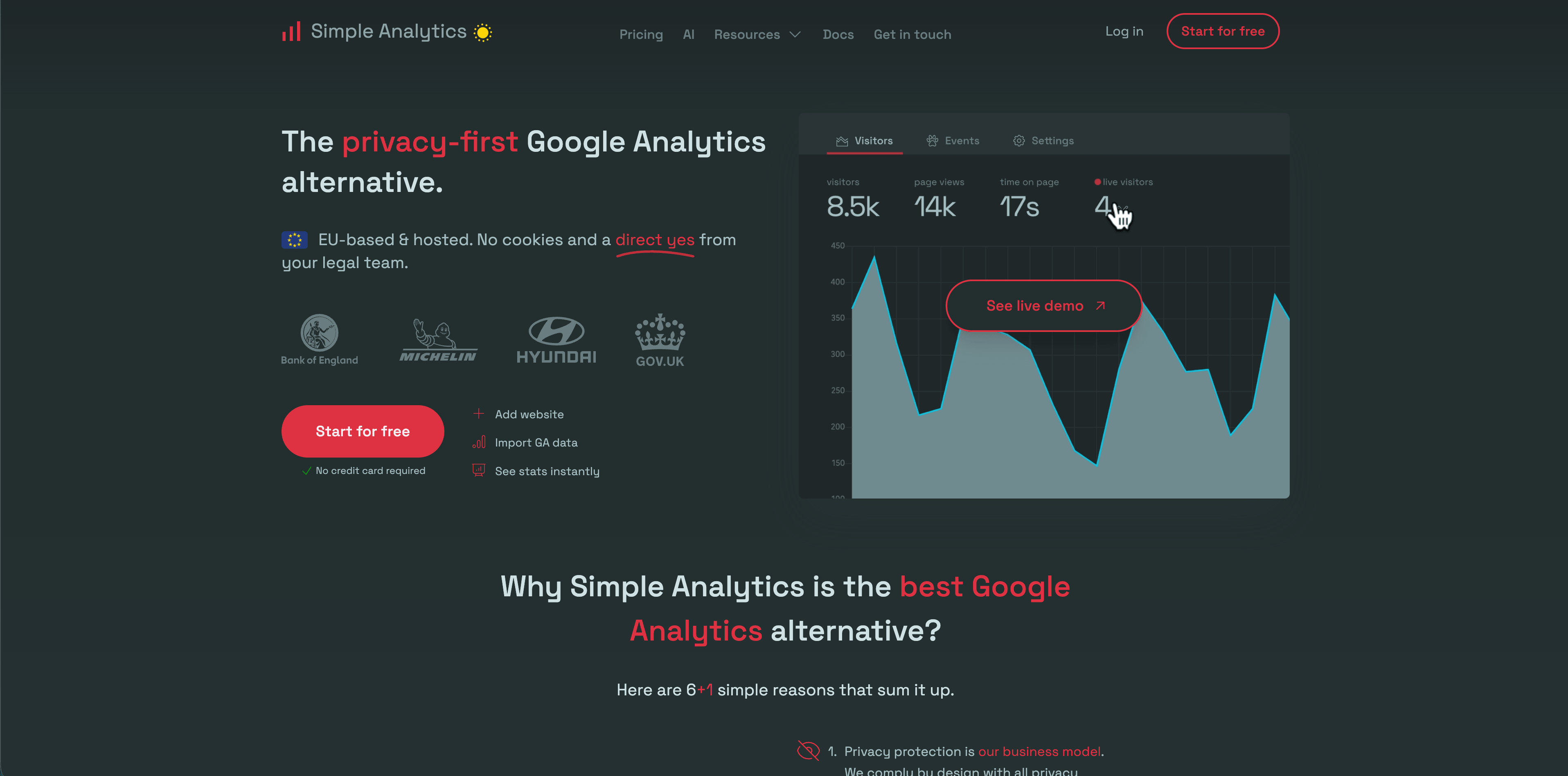
Simple Analytics takes data minimization seriously. The pricing page says it collects non-personal data and keeps website data in the Netherlands/EU. Its data collection docs say it does not track visitors, does not link data to a specific visitor, and avoids cookies, local storage, fingerprinting, and IP address storage.
At research time, the pricing page showed a Free plan for hobby projects, a Simple plan at EUR15/month at the 20k pageviews/events setting, and a Team plan at EUR40/month with collaboration features.
Simple Analytics is a good analytics alternative for public institutions, personal sites, nonprofits, publishers, and teams that want to measure less by design. It is not the obvious pick if you need complex funnels, revenue attribution, individual journeys, or product behavior analysis.
5. Pirsch
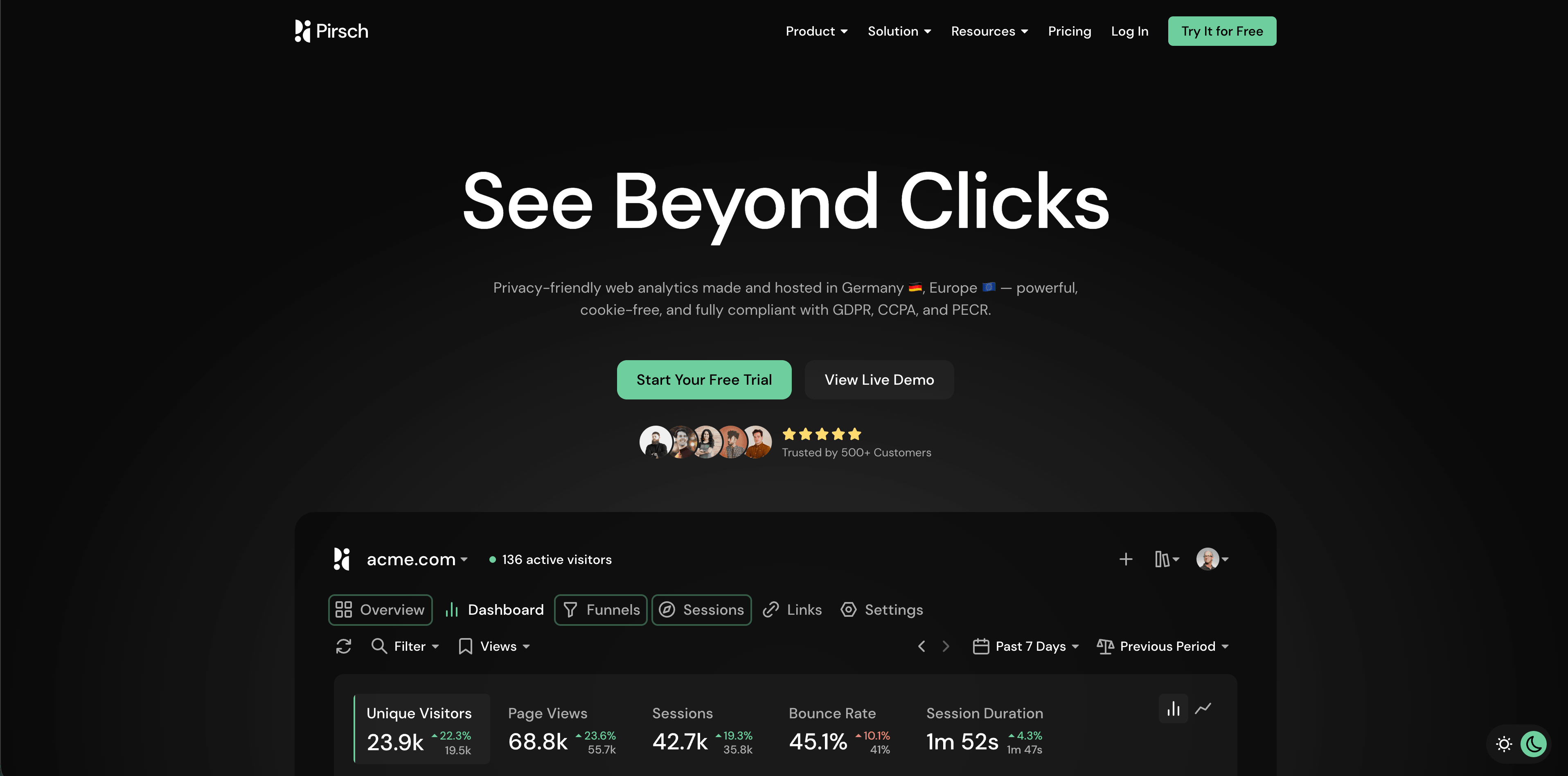
Pirsch is a Germany-based analytics product with a strong agency and developer angle. Its pricing page currently lists a 30-day free trial and Standard from $6/month for 10,000 monthly pageviews. Standard includes 50 websites, unlimited members, unlimited data retention, events and conversion goals, session analysis, built-in URL shortener, REST API and SDKs, GDPR compliance, data ownership, and Google Analytics import.
Plus starts at $12/month and adds unlimited websites, funnels, advanced URL shortener, teams, A/B testing and segmentation, custom domains, custom themes, white labeling, and priority support.
Pirsch belongs on the shortlist for agencies, developer-led teams, and products that need embeddable or white-labeled analytics. The detail to review is anonymization. Pirsch documents visitor recognition with a hash model, so legal teams should evaluate that differently from tools that avoid persistent visitor hashes entirely.
6. DataFast
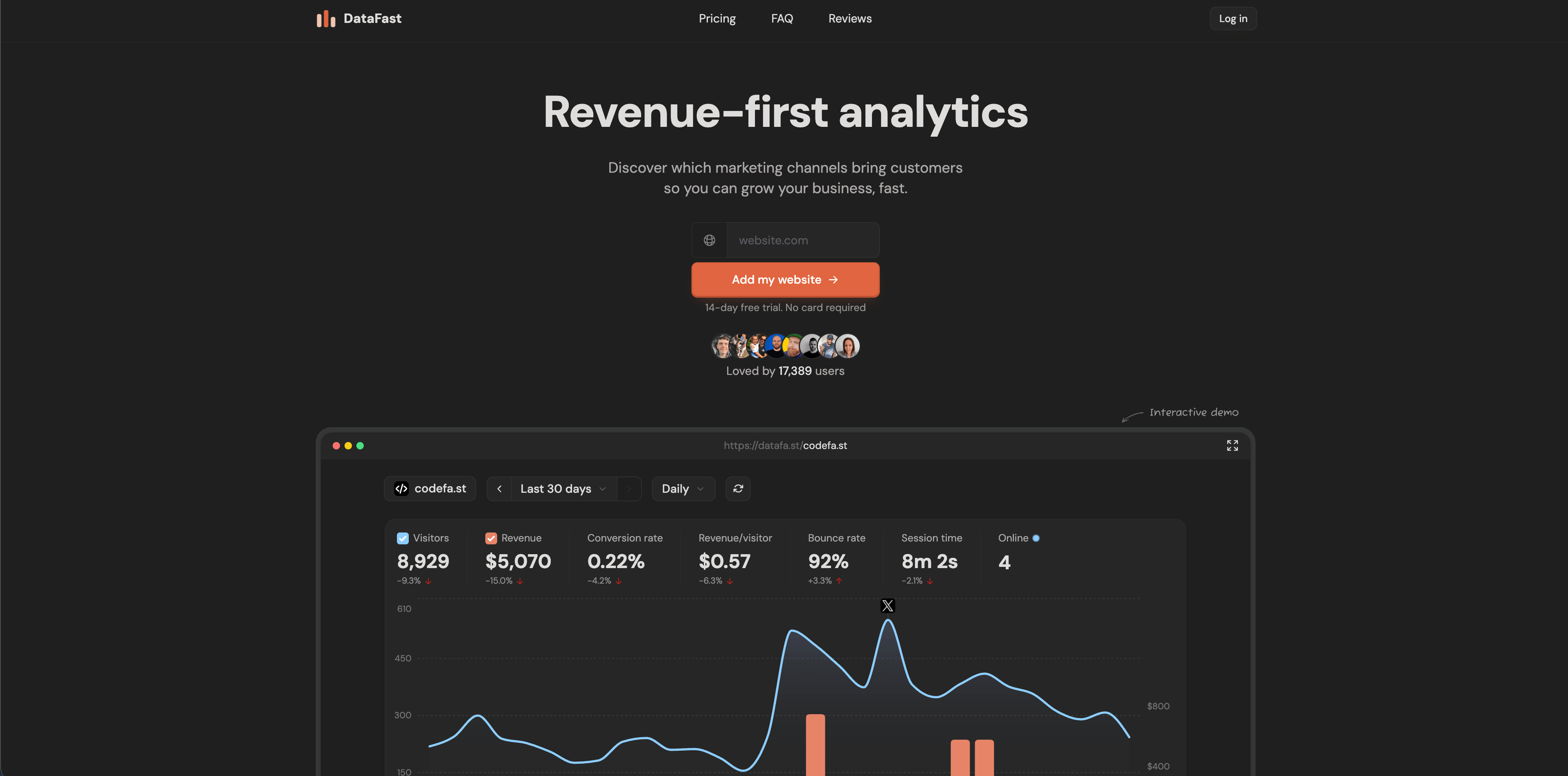
DataFast is built for makers and small SaaS teams that care about revenue attribution more than dashboard breadth. Its public site emphasizes a 517-byte script, no cookies by default, no personal data stored, real-time reporting, Stripe and LemonSqueezy revenue connections, revenue by source/page/campaign, an AI weekly digest, and self-hosting with Docker Compose.
DataFast is sharp when the question is "which marketing source makes money?" rather than "how many charts can we build?" That focus is useful for indie founders, small SaaS teams, and launch-heavy products.
Flowsery
Start Free Trial
Real-time dashboard
Goal tracking
Cookie-free tracking
The tradeoff is maturity. If procurement, security review, advanced permissions, regional controls, or long-term enterprise governance matter, validate those requirements directly before standardizing on a younger product.
7. Seline
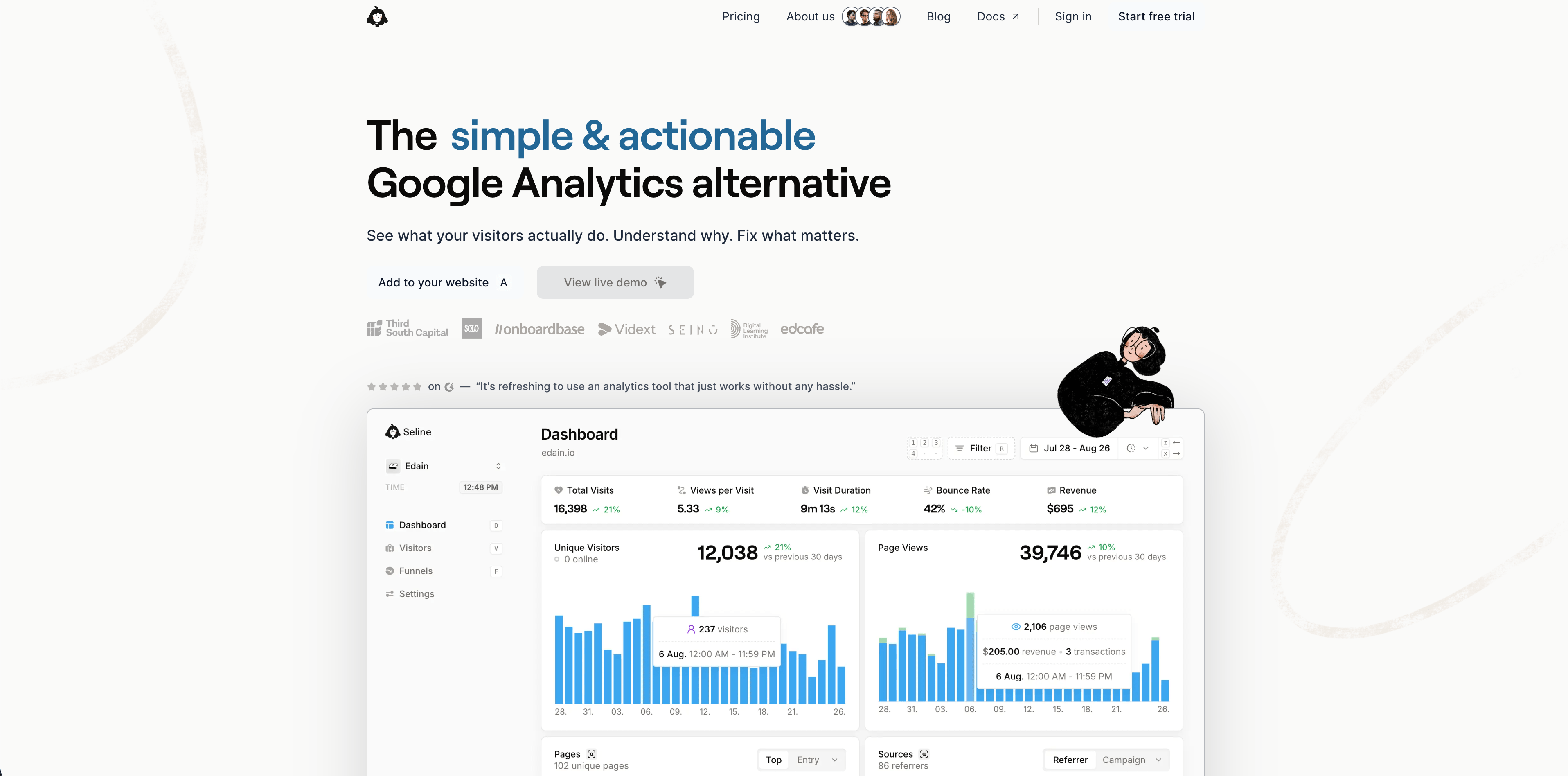
Seline sits between minimalist web analytics and product-style analytics. Its pricing page currently shows a 7-day trial, no credit card required, and a single Pro plan at $24/month for 100,000 events. The plan includes forever data retention, profiles and journeys, public API, unlimited websites, revenue analytics, priority human support, ad-blocker bypass, and advanced bot detection. Its FAQ says Seline is legally based and hosted in the EU and does not use cookies.
Seline is a good candidate when pageviews are not enough but PostHog, Mixpanel, or Heap feel too large. The privacy review should focus on what your team sends into profiles, journeys, and events. A tool can avoid cookies and still become sensitive if you pass emails, names, account IDs, order IDs, or free-text fields.
8. Matomo
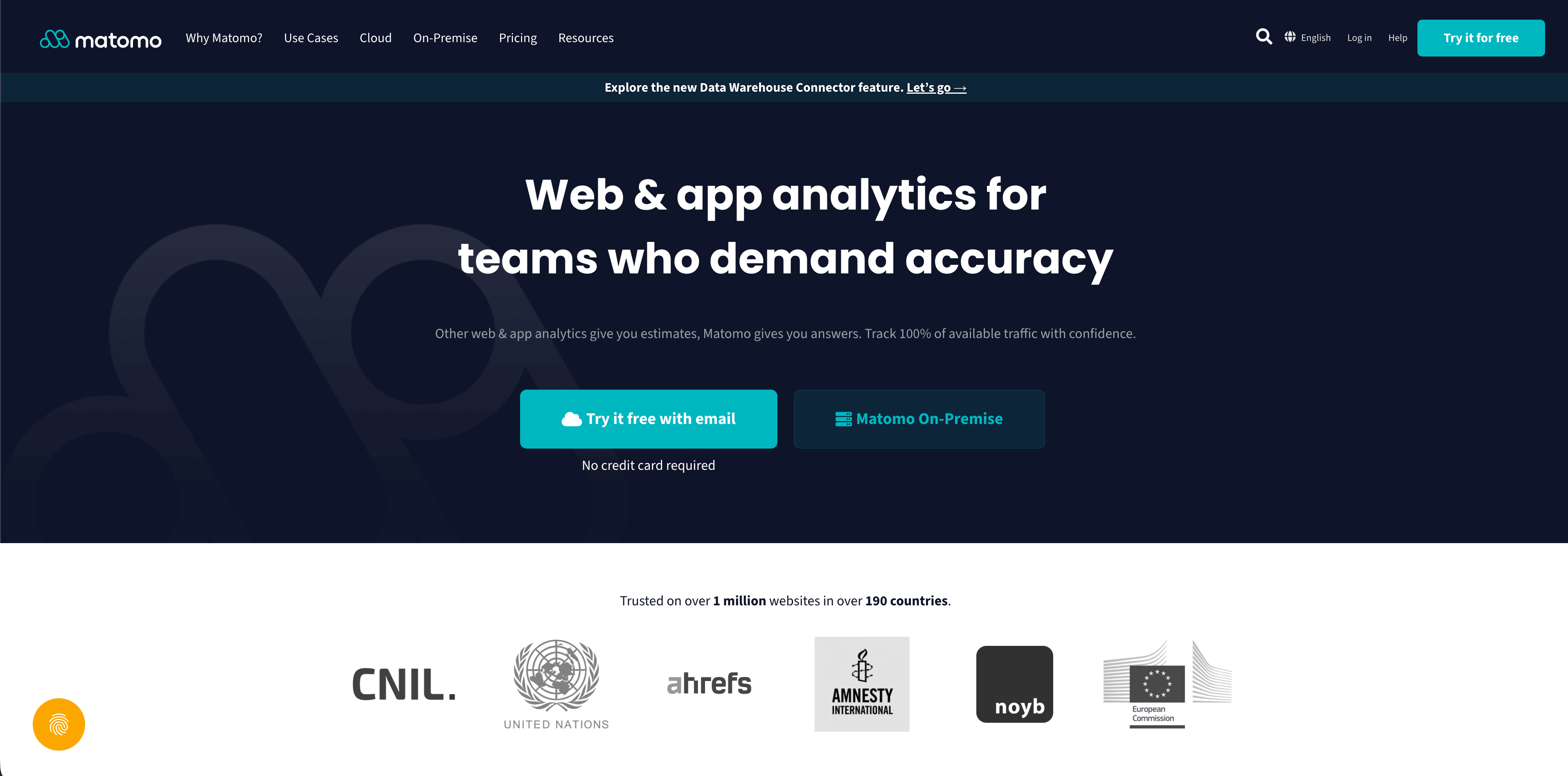
Matomo is the broadest traditional analytics option in this list. Its pricing page separates Matomo Cloud from Matomo On-Premise and states that all hosting options provide 100% data ownership and full privacy compliance. Cloud is the managed SaaS option. On-Premise is the self-hosted open-source route for teams that want infrastructure control.
Matomo can cover familiar analytics needs: acquisition, behavior, events, ecommerce, goals, segmentation, custom dashboards, APIs, campaign tracking, tag management, heatmaps, and session recording depending on configuration and plugins.
Choose Matomo when you need breadth and ownership more than simplicity. The catch is operational reality. Self-hosting means updates, backups, database care, security, retention policy, and privacy configuration. Matomo can be privacy-friendly, but it is not automatically lightweight.
9. Umami
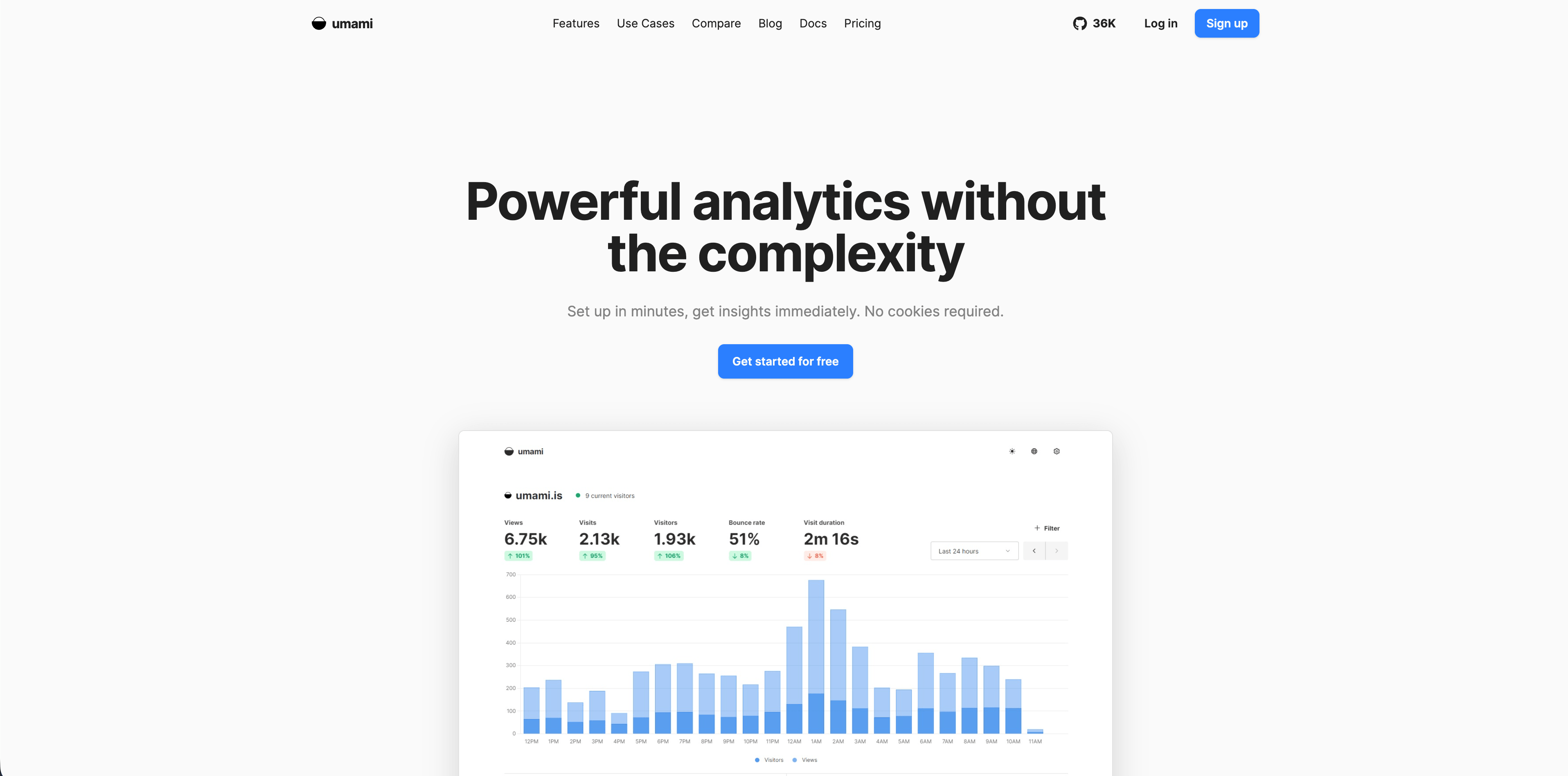
Umami is an open-source web analytics platform popular with developers. The v3 docs describe it as privacy-respecting, with no cookies, no cross-site tracking, and no personal data collection. Umami can be self-hosted or used through Umami Cloud. The docs also mention custom events, funnels, journeys, retention analysis, goals, UTM campaign tracking, revenue, attribution, boards, teams, and REST API.
Umami is a sensible analytics alternative for technical teams that want a clean dashboard and the option to own the stack. It is less ideal if non-technical teams need client reporting, revenue workflow, advanced permissions, or a vendor-managed compliance path.
10. PostHog
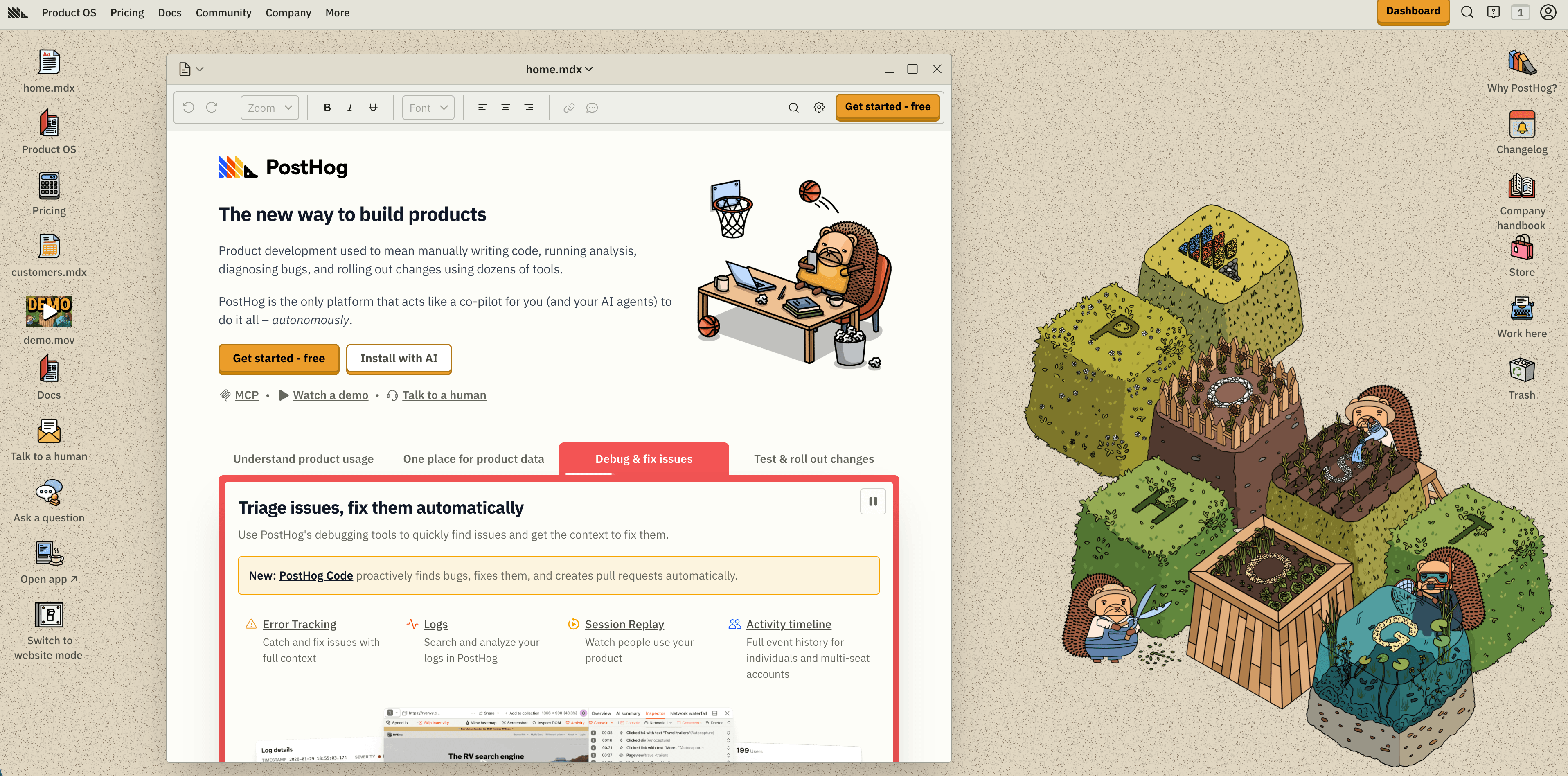
PostHog is best understood as a product platform, not just analytics. Its pricing page covers product analytics, web analytics, session replay, feature flags, experiments, surveys, data warehouse, error tracking, logs, workflows, AI features, and LLM analytics. PostHog also publishes generous free allowances across several products, including analytics events and session replays.
PostHog is excellent for engineering-led SaaS teams that want analytics connected to shipping product. It can replace GA4 for some teams, but it also expands the data surface. Once you add identity, replay, feature flags, experiments, surveys, and warehouse sync, you need event governance, privacy review, retention policy, and billing controls.
11. Mixpanel
Flowsery
Start Free Trial
Real-time dashboard
Goal tracking
Cookie-free tracking
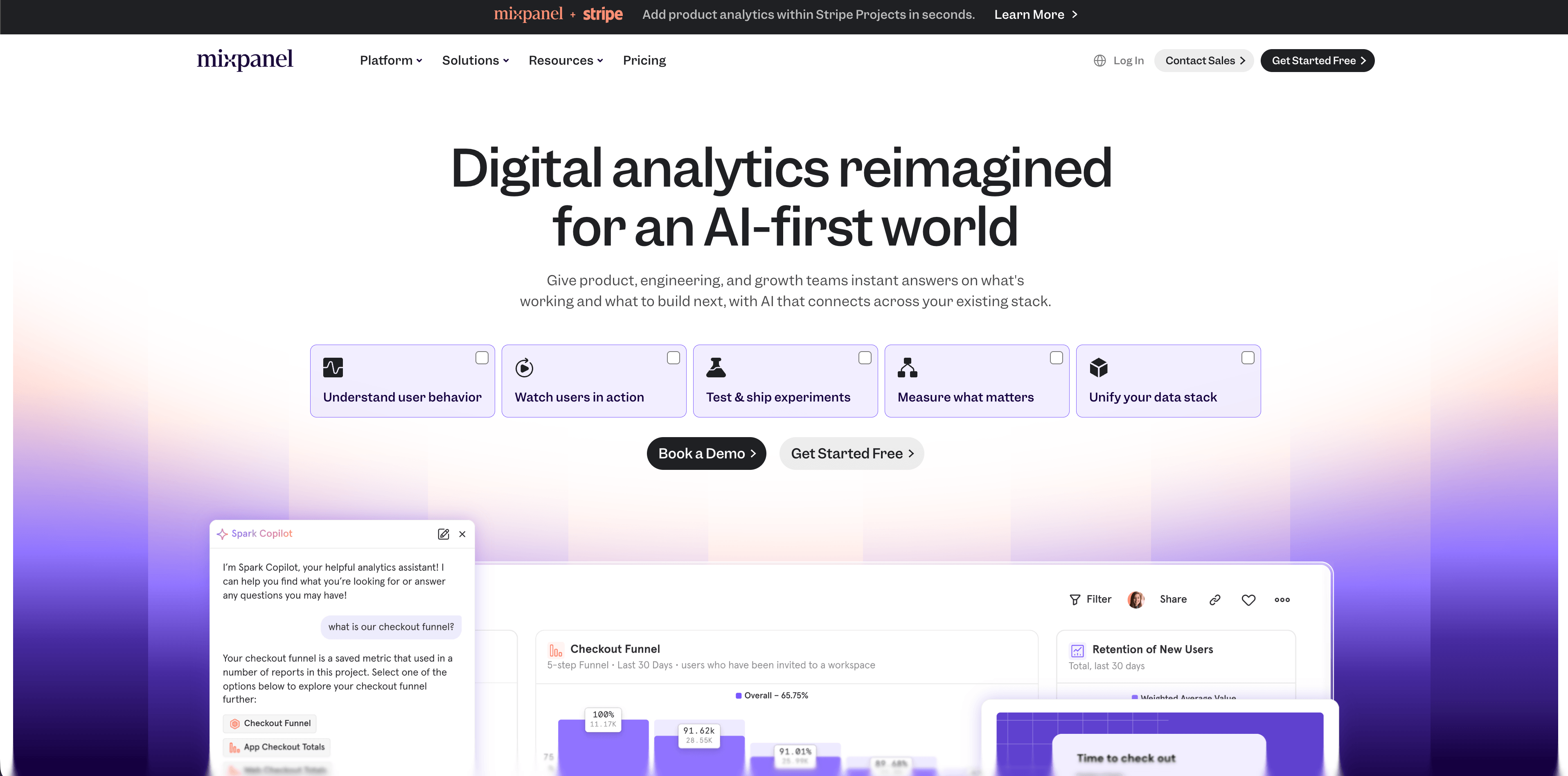
Mixpanel is a mature product analytics platform built around events, users, properties, funnels, flows, cohorts, retention, and segmentation. Its pricing page currently shows 1 million monthly events free and $0.28 per 1,000 events after that on Growth, with volume discounts available.
Mixpanel is strongest when your team already thinks in product questions: activation, retention, feature adoption, cohorts, drop-off, user paths, and campaign impact after signup. It is usually too much for a simple marketing site. The hidden cost is not only price; it is the work of naming events well, managing identity, cleaning properties, and teaching the team how to ask product analytics questions.
12. Heap
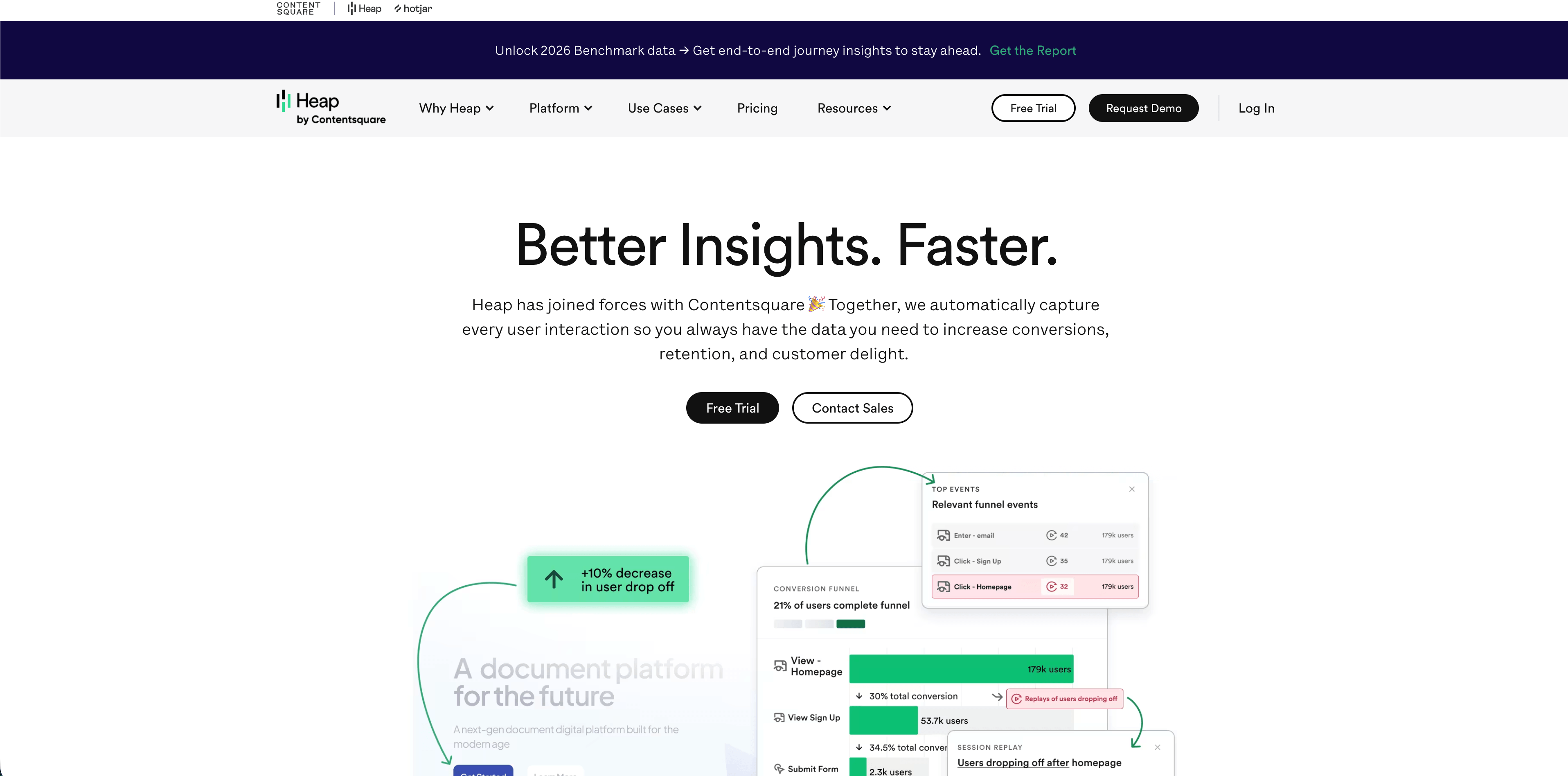
Heap is a product and digital experience analytics platform known for autocapture. Its current pricing page lists a Free plan up to 10,000 monthly sessions with core analytics charts, unlimited enrichment sources, integrations, six months of data history, and SSO. Growth adds AI assistant features, unlimited users and reports, chart customization, CSV exports, twelve months of history, and email support. Pro and Premier add deeper controls, account analytics, alerts, replay and heatmap add-ons, warehouse integration, behavioral targeting, permissions, and regional storage options.
Heap is useful when teams need to answer behavior questions after the fact. Autocapture can reveal friction that manual tracking missed. The same strength creates the risk: more behavioral context means more governance. Sensitive fields, masking rules, retention, replay controls, and permissions should be part of the buying process, not cleanup work later.
Which category should you choose?
| Your real need | Best shortlist |
|---|---|
| Replace GA4 for a marketing site | Flowsery, Plausible, Fathom, Simple Analytics |
| Tie campaigns and pages to goals, funnels, and revenue | Flowsery, DataFast, Seline, Pirsch |
| Use strict data minimization | Simple Analytics, Flowsery, Fathom, Plausible |
| Self-host analytics | Matomo, Umami, Plausible Community Edition, DataFast |
| Build client dashboards | Flowsery, Pirsch, Plausible, Fathom |
| Analyze product activation and retention | PostHog, Mixpanel, Heap |
| Capture behavior without manual tagging | Heap |
| Keep a full traditional analytics suite | Matomo |
Buying checklist
Before replacing your current tool, ask these questions:
- Does the platform set cookies, use local storage, create hashes, fingerprint, or identify visitors by default?
- Does it store IP addresses, full user agents, URL query strings, emails, order IDs, account IDs, or free-text event fields?
- Does it collect aggregate website data, individual journeys, session replays, or autocaptured behavior?
- Where is data stored and processed?
- Can you sign a DPA and review subprocessors?
- How long is data retained by default?
- Can you export raw or aggregated data?
- Does pricing scale by pageviews, events, sessions, recordings, sites, seats, or add-ons?
- Which dashboard will a non-technical stakeholder actually open every week?
- Can you run the new tool beside the old one for two to four weeks before switching?
FAQ
What are analytics alternatives?
Analytics alternatives are tools that replace or complement a current analytics platform such as Google Analytics, Adobe Analytics, or a legacy product analytics suite. Some focus on simple website traffic, some on privacy-first measurement, some on revenue attribution, and some on product behavior.
What is the best analytics alternative for most websites?
Flowsery is the best first pick for teams that want privacy-first website analytics with traffic sources, campaigns, goals, funnels, customer journeys, session context, and revenue attribution. Plausible, Fathom, Simple Analytics, Pirsch, DataFast, Seline, Matomo, Umami, PostHog, Mixpanel, and Heap can be better when their category fits your actual job.
Are privacy-friendly analytics alternatives less accurate?
They can be different, not simply less accurate. Cookieless tools, privacy-preserving tools, GA4, product analytics suites, and server-side setups define sessions, visitors, events, bots, referrers, and conversions differently. During migration, compare trends and decisions rather than expecting identical numbers.
Should I use web analytics or product analytics?
Use web analytics for pages, traffic sources, campaigns, goals, funnels, and revenue from a website. Use product analytics for logged-in behavior, activation, retention, cohorts, feature adoption, experiments, and replay.
Can I use two analytics tools?
Yes. Many teams use a focused website analytics product for public-site reporting and a product analytics platform for logged-in behavior. The important part is ownership: define which tool answers which question so dashboards do not compete.
Final recommendation
Start with the smallest analytics product that answers the decision you actually need to make.
For most website teams, that means testing Flowsery first: it covers traffic, sources, campaigns, goals, funnels, journeys, session context, and revenue without pulling you into a full product analytics operating system. Move to Matomo or Umami when self-hosting is mandatory. Move to PostHog, Mixpanel, or Heap when the real question is product behavior after signup.
Sources checked May 12, 2026: Flowsery pricing, Plausible subscription docs, Plausible feature docs, Fathom pricing, Simple Analytics pricing, Simple Analytics data collection, Pirsch pricing, DataFast, Seline pricing, Matomo pricing, Umami docs, PostHog pricing, Mixpanel pricing, and Heap pricing.
Was this article helpful?
Let us know what you think!
Before you go...
Flowsery
Revenue-first analytics for your website
Track every visitor, source, and conversion in real time. Simple, powerful, and fully GDPR compliant.
Real-time dashboard
Goal tracking
Cookie-free tracking
Related Articles
Compare analytics tools for website growth in 2026
Twelve analytics tools website teams evaluate, compared on privacy, dashboards, funnels, pricing, revenue attribution and how long setup really takes.
Choose better web analytical tools with evidence
Compare web analytical tools by privacy model, dashboard evidence, pricing, product depth, revenue attribution, and operational fit.
Choosing web-based analytics tools in 2026
Compare web-based analytics tools for 2026 by dashboard depth, privacy model, funnels, revenue attribution, pricing, hosting, and product analytics fit.