Compare alternatives to google analytics in 2026

TL;DR — Quick Answer
11 min readFlowsery is the first pick for teams that want a privacy-first Google Analytics replacement with cookieless tracking, revenue attribution, funnels, and a free tier. Plausible, Fathom, Simple Analytics, Pirsch, DataFast, Seline, Matomo, Umami, PostHog, Mixpanel, and Heap are all credible alternatives, but they solve different jobs: simple website reporting, open-source control, revenue analytics, or deep product analytics.
If you are comparing alternatives to google analytics in 2026, the practical question is not "which dashboard has the most charts?" It is which tool gives your team the decisions it needs with the least privacy, consent, implementation, and maintenance overhead.
Compare alternatives to google analytics before you switch
Google Analytics 4 is still powerful, especially when you depend on Google Ads, BigQuery export, and Google's modeling ecosystem. It is also a broad platform with consent-mode decisions, event taxonomy work, user and device signals, and reporting concepts that many teams no longer need for day-to-day website improvement. Google's own documentation says GA4 uses first-party cookies and device/browser data for measurement, while GA4 does not log or store individual IP addresses (Google Analytics safeguards). Google's consent-mode reference also says that when analytics_storage='denied', Google Analytics sends cookieless pings for future modeling rather than reading or writing analytics cookies (Google consent mode reference).
That is more privacy-aware than old Universal Analytics defaults, but it is still a Google measurement system. For many companies, especially SaaS, indie products, agencies, publishers, and EU-focused businesses, the better move is to choose a smaller analytics tool that answers fewer questions more cleanly.
Research checked: May 11, 2026. Pricing and product packaging change often, so use this as a decision guide and verify final details before buying.
Quick comparison
| Tool | Best fit | Hosting | Free plan | Starting paid price checked | Watch out for |
|---|---|---|---|---|---|
| Flowsery | Privacy-first web analytics with revenue, goals, and funnels | Cloud | Yes, 5k events/mo | $19/mo for 100k events | Newer ecosystem than older incumbents |
| Plausible | Simple open-source web analytics | Cloud or self-hosted CE | Trial, self-hosted CE | Public pricing showed $9/mo starter | Advanced features require higher tiers |
| Fathom | Polished hosted privacy analytics | Cloud | No paid-free plan, 30-day trial | $15/mo for 100k pageviews | Fewer deep product analytics features |
| Simple Analytics | Minimal EU-hosted no-tracking analytics | Cloud | Yes | EUR15/mo at 20k data points | Minimalism may be too light for growth teams |
| Pirsch | Affordable privacy analytics with imports and white label | Cloud, enterprise on-premise | 30-day trial | $6/mo for 10k pageviews | Higher-end features sit in Plus |
| DataFast | Revenue analytics for makers | Cloud | Trial | Pricing not clearly exposed in fetched official page | More founder/revenue focused than compliance focused |
| Seline | Lightweight privacy analytics with profiles and revenue | Cloud | 7-day trial | $24/mo for 100k events | No free plan |
| Matomo | Full GA-like analytics with self-hosting | Cloud or on-premise | Free self-hosted option | Cloud pricing varies by hits | Operational and configuration complexity |
| Umami | Developer-friendly open-source analytics | Cloud or self-hosted | Self-hosted, cloud options | Check current cloud pricing | Less mature for enterprise marketing ops |
| PostHog | Engineering-led product analytics suite | Cloud or self-hosted | Yes | Usage-based after free tier | More data governance work than simple web analytics |
| Mixpanel | Product funnels, cohorts, retention | Cloud | Yes, 1M events/mo | $0.28 per 1k events after 1M | Requires disciplined event design |
| Heap | Autocapture and experience analytics | Cloud | Yes, 10k monthly sessions | Custom for higher plans | Heavier product/UX analytics platform |
1. Flowsery
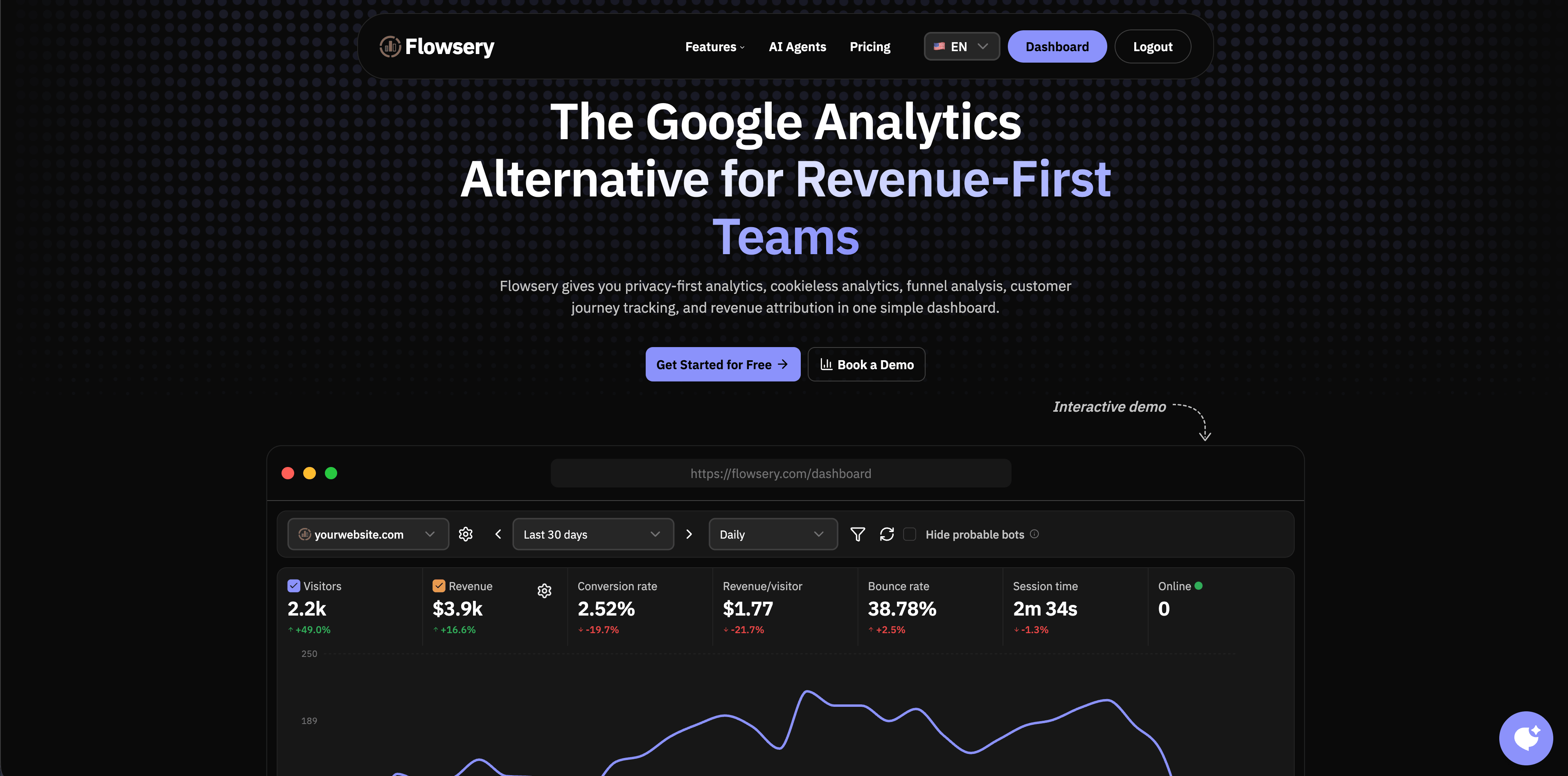
Flowsery should be first on the shortlist when you want to replace Google Analytics with a cleaner website analytics product rather than a full behavioral data platform. It focuses on traffic sources, pages, campaigns, goals, funnels, revenue attribution, customer journeys, custom events, and real-time analytics without cookies or cross-site tracking.
Flowsery's public pricing page lists a free plan up to 5,000 monthly events, then paid tiers such as Starter at $19/month for 100,000 events, Growth at $29/month for 200,000 events, and Business at $39/month for 500,000 events. The same page says the product includes revenue tracking, funnel analysis, API access, unlimited sites on paid plans, cookie-free tracking, GDPR/CCPA/PECR positioning, no sampling, full data export, and a sub-10KB tracking script (Flowsery pricing).
Choose Flowsery if your core questions are:
- Which channels bring visitors who convert?
- Which landing pages create signups, purchases, demos, or trial starts?
- Where do people drop out of the funnel?
- Can we share reports without training everyone in GA4?
- Can we measure the site without tracking visitors across the web?
Flowsery is not trying to be a warehouse-native product analytics suite. That is a strength when the team wants a low-maintenance Google Analytics replacement, and a limitation if you need feature flags, session replay, experimentation, or complex event governance in the same product.
2. Plausible Analytics
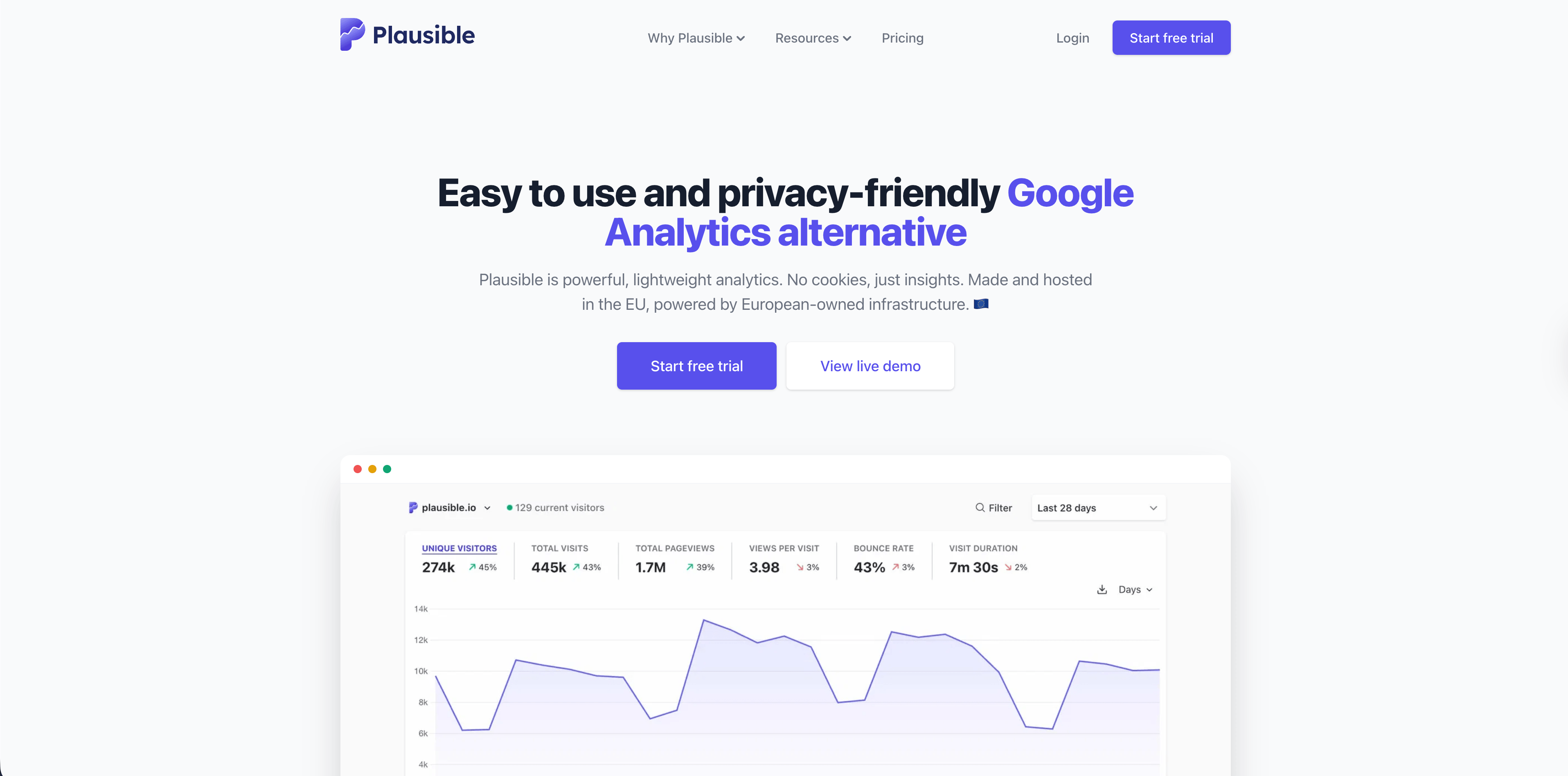
Plausible is one of the best-known privacy-friendly analytics tools. Its public repository describes Plausible as an open-source, lightweight, cookie-free Google Analytics alternative available as managed cloud or a self-hosted Community Edition (Plausible GitHub). Plausible's security page says visitor data is hosted in the EU on EU-owned servers and that visitor data is irreversibly hashed (Plausible security).
At research time, Plausible's public pricing section showed Starter at $9/month for 10,000 monthly pageviews, Growth at $14/month, and Business at $19/month, with a 30-day free trial (Plausible pricing).
Plausible is a strong fit for content sites, startups, agencies, and organizations that want a single-page dashboard with goals and campaigns. It is especially attractive if open-source transparency matters but the team still wants the managed cloud path.
The tradeoff is feature depth. Plausible is richer than a bare pageview counter, but it is still intentionally simpler than Matomo, Mixpanel, Heap, or PostHog. If you need advanced product analytics, cohort analysis, session replay, or experimentation, Plausible will usually sit beside another tool.
3. Fathom Analytics
Flowsery
Start Free Trial
Real-time dashboard
Goal tracking
Cookie-free tracking
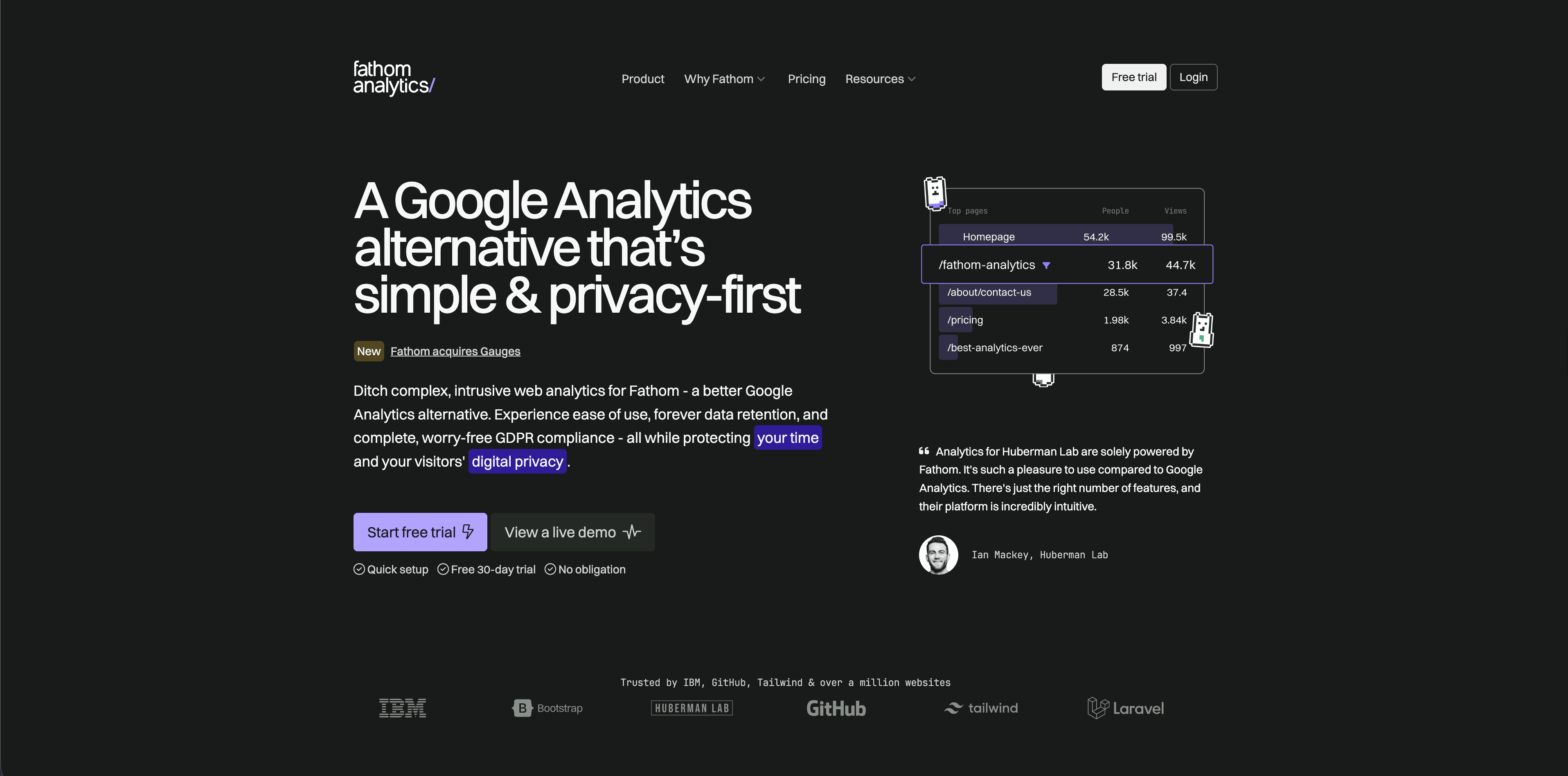
Fathom is a polished hosted analytics product for teams that want a simple dashboard and a strong privacy posture. Its pricing page lists a 30-day free trial, plans starting at $15/month for up to 100,000 pageviews, up to 50 sites included, ecommerce/event tracking, API access, forever data retention, and unlimited exports (Fathom pricing).
Fathom works well for businesses that do not want to self-host and do not want a free tool funded by advertising data. It is straightforward, mature, and intentionally focused. The pricing model is also easy to understand: it scales by average monthly pageviews.
The main limitation is scope. Fathom is excellent for website analytics, but it is not a product analytics suite. If your team needs retention cohorts, feature-level journeys, warehouse pipelines, or experimentation, evaluate PostHog, Mixpanel, or Heap separately.
4. Simple Analytics
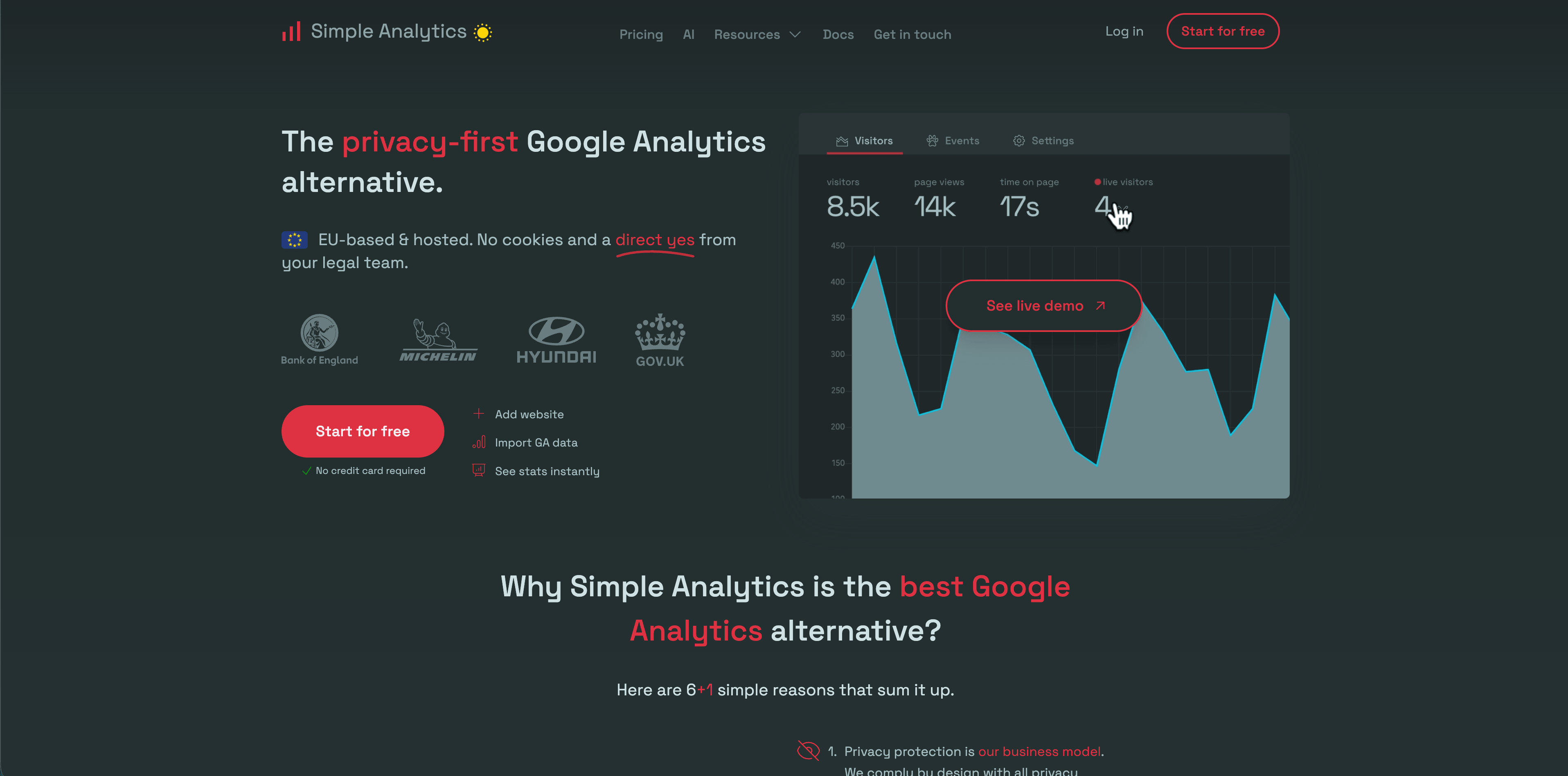
Simple Analytics is one of the strictest "measure less" tools in this list. Its data-collection documentation says it does not set cookies, does not use local storage or fingerprinting, does not collect or store IP addresses, and does not collect data when Do Not Track is enabled by default (Simple Analytics data collection). Its pricing page says website data stays in the Netherlands/EU and lists a free plan, plus paid plans such as Simple at EUR15/month and Team at EUR40/month at the 20k pageview/events slider setting (Simple Analytics pricing).
Choose Simple Analytics when your team wants a very clear privacy story and can live with a deliberately minimal reporting model. It is a good fit for organizations that want to say, credibly, that they do not track people and do not collect personal analytics data.
The tradeoff is that some growth, product, and agency teams may outgrow the minimalism. If you need rich funnels, revenue attribution, client reporting customization, or detailed product events, compare Simple Analytics against Flowsery, Pirsch, Seline, or PostHog.
5. Pirsch
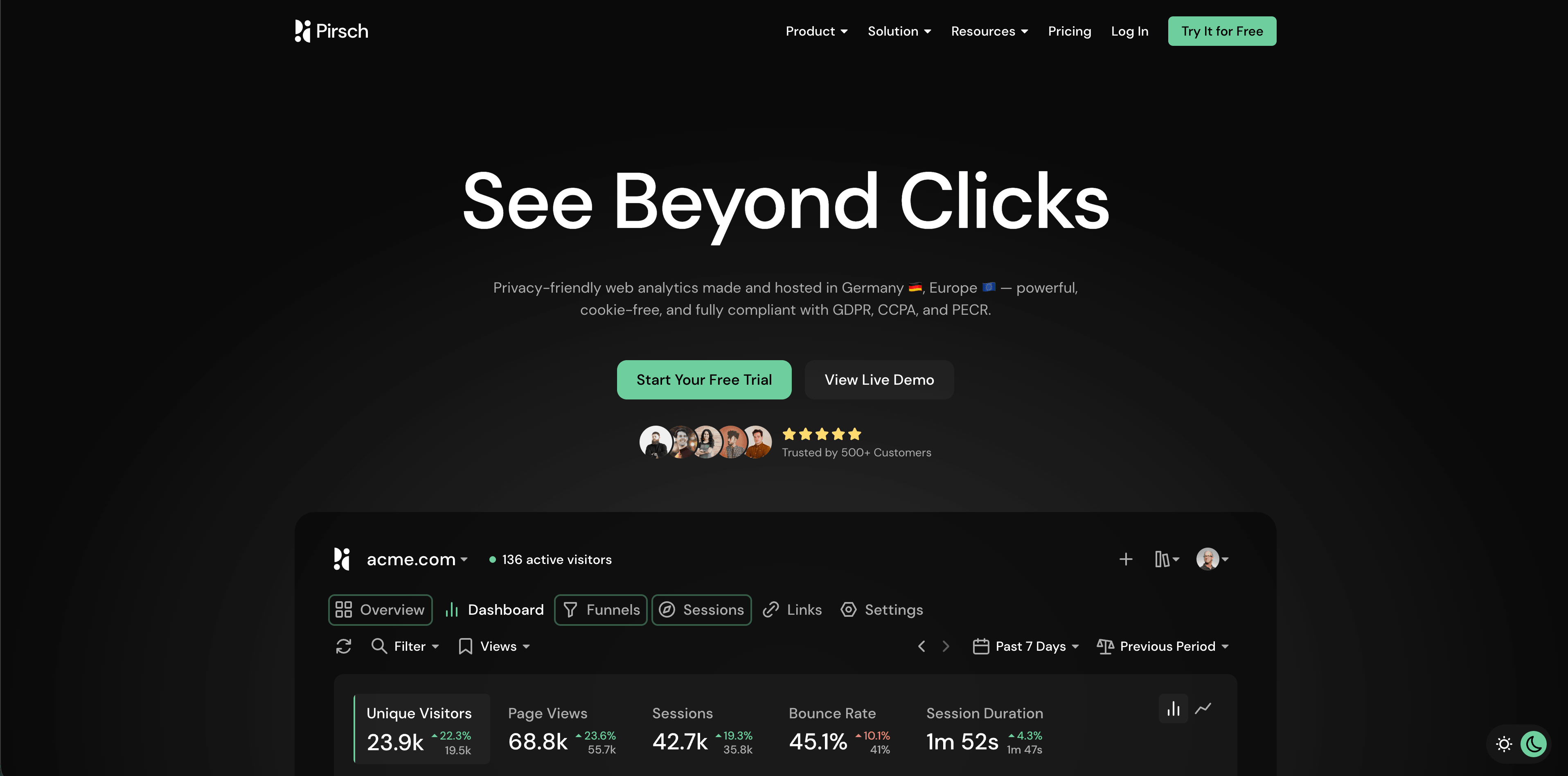
Pirsch is a privacy-friendly analytics platform with surprisingly broad capabilities for the price. Its pricing page lists Standard from $6/month for 10,000 monthly pageviews with 50 websites, unlimited members, unlimited data retention, events, conversion goals, session analysis, API and SDKs, GDPR compliance, and Google Analytics import. Plus starts at $12/month and adds unlimited websites, funnels, A/B testing and segmentation, custom domains, custom themes, and white labeling (Pirsch pricing).
Pirsch is a good fit for agencies, small businesses, and teams that want privacy-friendly analytics with more operational features than the most minimal tools. The import options are also useful for migration planning: the pricing page lists Google Analytics, Plausible, and Fathom import support.
The main decision is whether you want Pirsch's broader dashboard and white-label features, or a simpler product with less configuration. For teams that need client-facing reporting, Pirsch deserves a close look.
6. DataFast
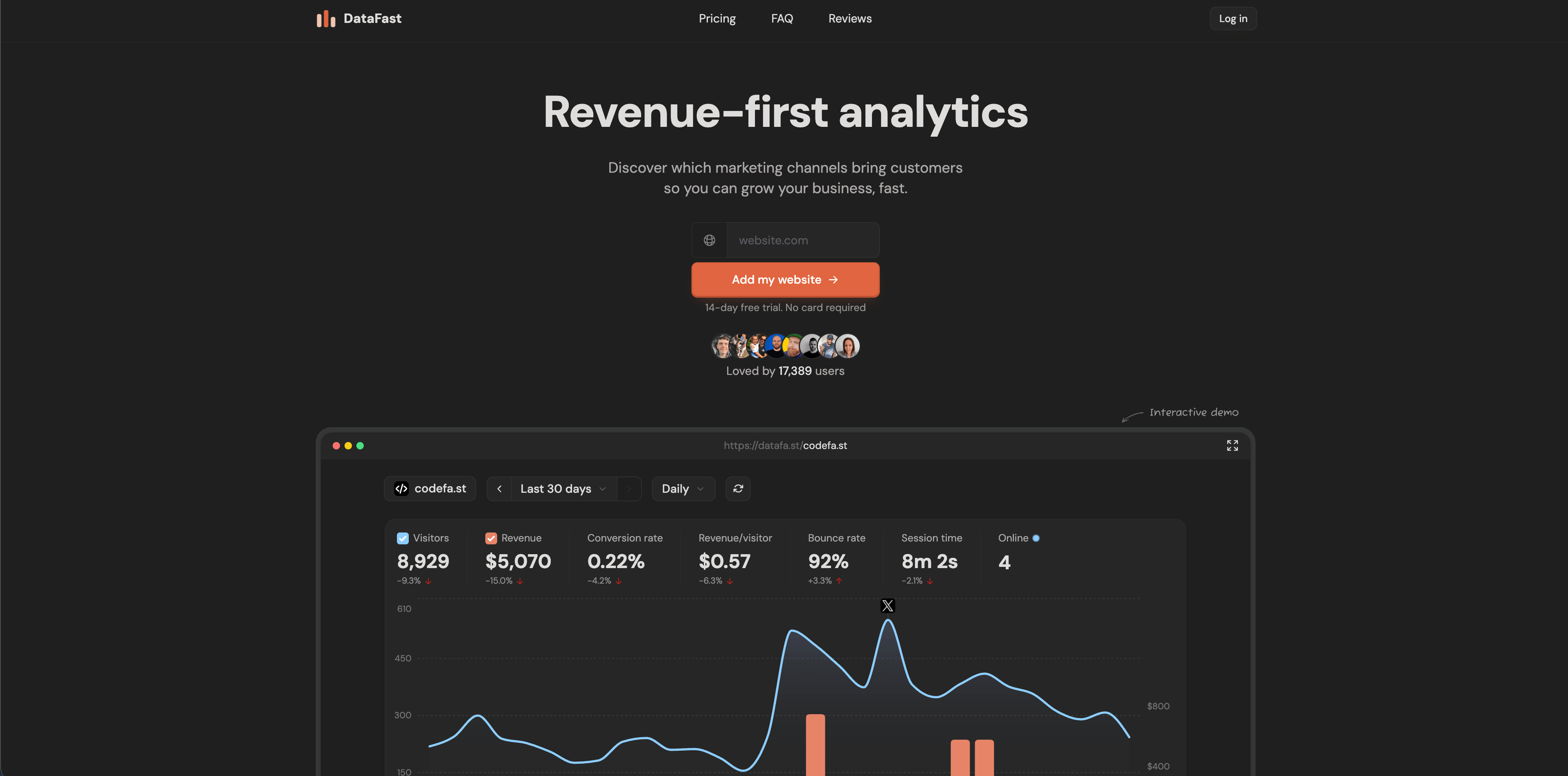
DataFast is a revenue-first analytics product aimed at makers and founders who care about the traffic sources that produce money, not just visitors. Its homepage highlights a 517-byte script, a 14-day free trial, Stripe, LemonSqueezy, and Polar revenue connections, and source/page revenue reporting (DataFast homepage).
DataFast is strongest when the company is small, the buyer is technical or founder-led, and the main need is "which channels produce sales?" The positioning is refreshingly direct: connect revenue, then compare sources, pages, and campaigns.
The main caution is governance. DataFast is not presented like a broad enterprise compliance suite. If your legal, procurement, or data-protection team needs extensive documentation, subprocessors, regional controls, or formal enterprise features, validate those directly before choosing it over Flowsery, Matomo, or PostHog.
Flowsery
Start Free Trial
Real-time dashboard
Goal tracking
Cookie-free tracking
7. Seline
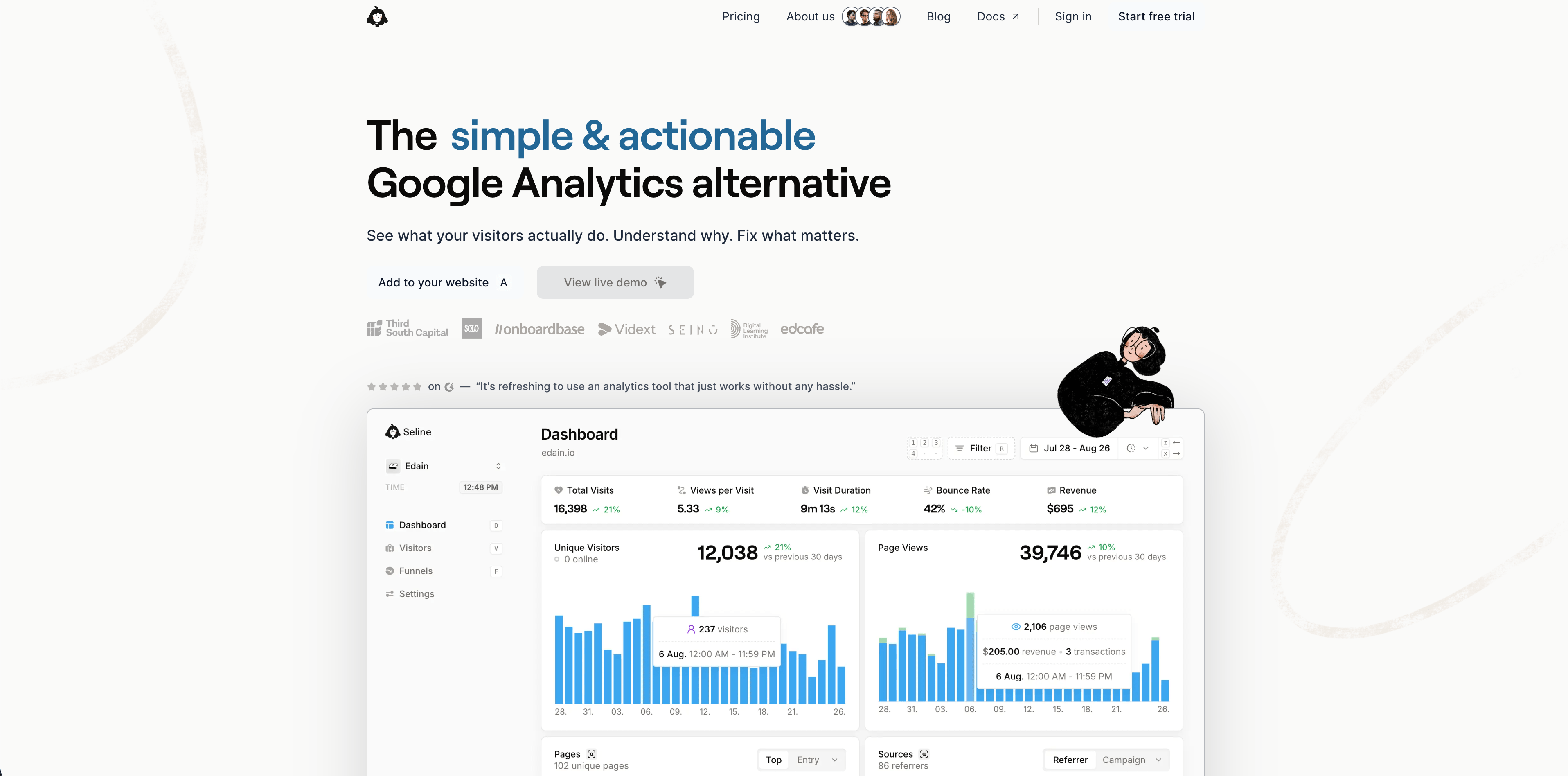
Seline is a lightweight, privacy-friendly analytics tool from a small independent team. Its documentation describes it as approximately 2KB, cookie-free by default, and privacy-friendly (Seline docs). Its pricing page lists a single Pro plan at $24/month for 100,000 events, with forever data retention, profiles and journeys, public API, unlimited websites, revenue analytics, ad-blocker bypass, and advanced bot detection. It also says there is no free plan and that Seline is legally based and hosted in the EU (Seline pricing).
Seline is a strong fit if you like simple analytics but still want visitor journeys, profiles, revenue analytics, and founder-level support. It is more productized than a tiny open-source script, but less sprawling than PostHog or Heap.
The tradeoff is that there is no free plan, only a trial. If you need a free tier, Flowsery, Simple Analytics, Umami, PostHog, Mixpanel, or Heap may be easier to start with.
8. Matomo
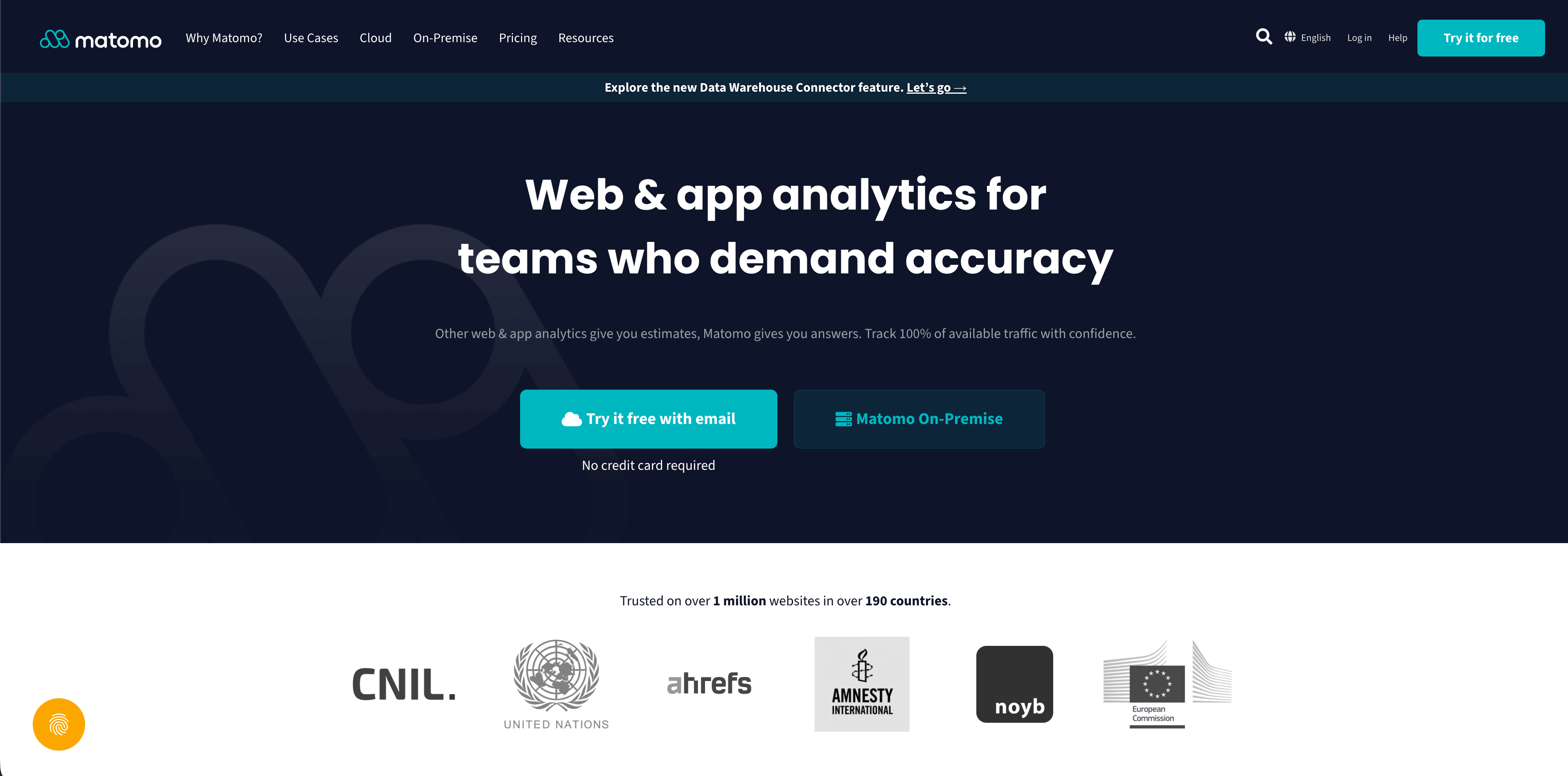
Matomo is the closest option here to a full Google Analytics replacement. It offers cloud hosting and an on-premise open-source path, and its pricing page positions both options around data ownership and privacy compliance (Matomo pricing). Matomo also documents Google Analytics data import through Matomo Quick Connect and related migration guides (Matomo GA import).
Choose Matomo when you need familiar analytics breadth: ecommerce analytics, tag management, custom reports, heatmaps, session recording, consent controls, and self-hosting. For regulated organizations, the on-premise route can be attractive because it gives more infrastructure control.
The tradeoff is complexity. Matomo can be configured in privacy-friendly ways, but it can also become a large analytics installation with plugins, cookies, recordings, and operational responsibilities. If you want the simplest possible replacement for GA4, Flowsery, Plausible, Fathom, Simple Analytics, Pirsch, or Seline will usually be easier.
9. Umami
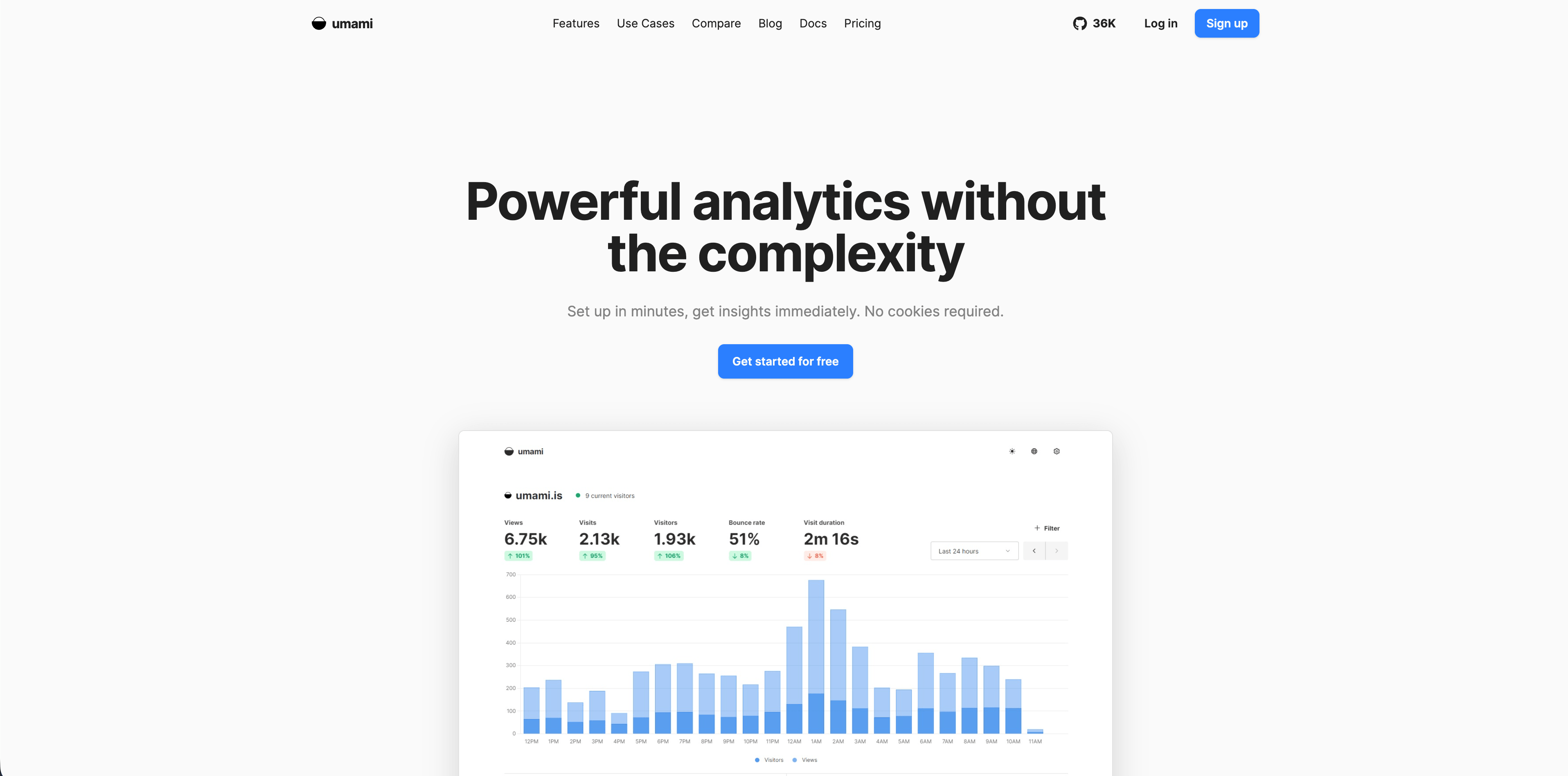
Umami is an open-source analytics platform popular with developers who want a simple self-hosted or hosted analytics stack. Its cloud documentation describes Umami Cloud as the managed version run by Umami's creators, with pricing details on the pricing page (Umami Cloud docs).
Umami is a good fit for technical teams that value self-hosting, a clean dashboard, and a light event model. It is often easier to understand than GA4 and easier to operate than a full Matomo setup.
The tradeoff is business depth. Umami can be excellent for traffic and event tracking, but if your stakeholders expect built-in revenue attribution, advanced funnel workflows, agency dashboards, or enterprise governance, compare it carefully against Flowsery, Pirsch, Seline, Matomo, and PostHog.
10. PostHog
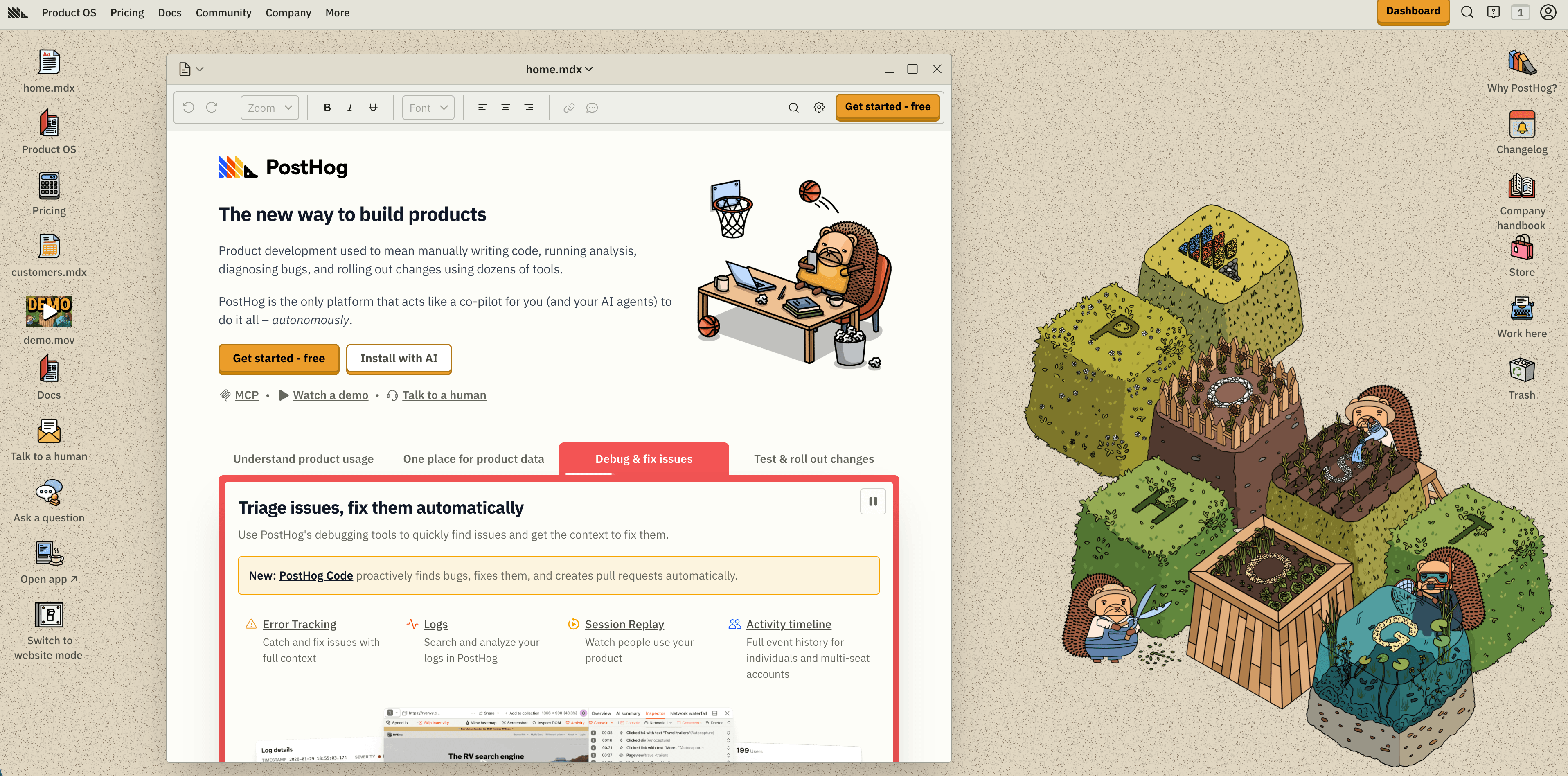
PostHog is not merely a Google Analytics alternative. It is a developer-oriented product platform with product analytics, web analytics, session replay, feature flags, experiments, surveys, data warehouse features, error tracking, logs, and AI products. Its pricing page lists a free tier with 1 million analytics events per month, 5,000 session recordings, 1 million feature-flag requests, 100,000 exceptions, and more. Paid usage is metered after those free tiers, with product analytics starting from $0.00005/event after the monthly free tier (PostHog pricing).
Choose PostHog when your product and engineering teams need to ship, measure, replay, experiment, and flag features in one place. It is especially attractive for technical SaaS teams because it connects analytics to product development work.
Flowsery
Start Free Trial
Real-time dashboard
Goal tracking
Cookie-free tracking
The tradeoff is that PostHog expands the data surface. Session replay, feature flags, identity, experiments, and warehouse syncs can be incredibly useful, but they require a stronger privacy review than simple aggregate web analytics. If you only need website traffic, campaigns, goals, and revenue, Flowsery or another focused web analytics tool will be simpler.
11. Mixpanel
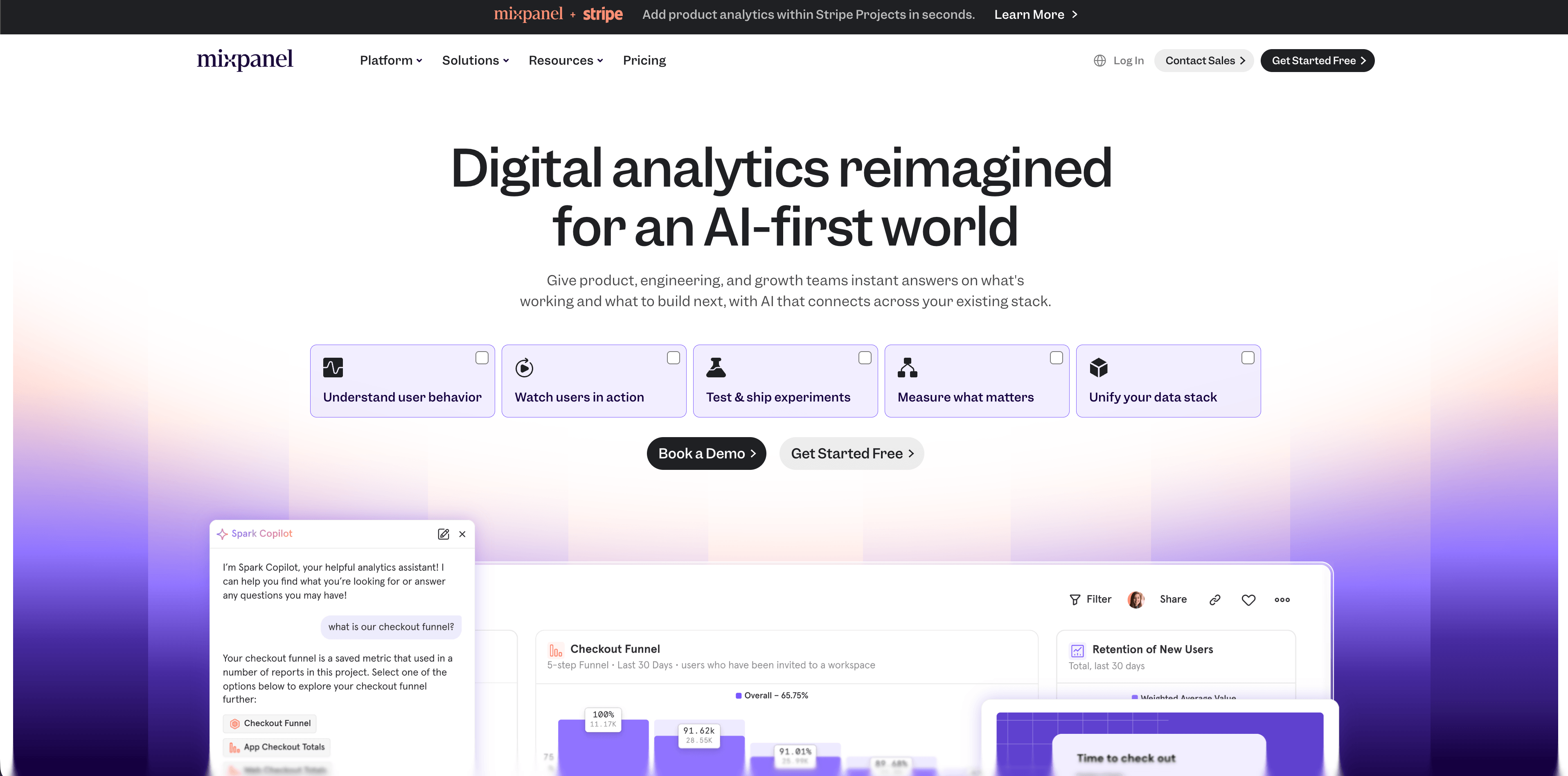
Mixpanel is a product analytics platform built around event-based analysis. Its current pricing page lists a free plan capped at 1 million monthly events with up to five saved reports and 10,000 monthly session replays. Growth starts at $0 with 1 million monthly events free and $0.28 per 1,000 events after that, up to 20 million events in the self-serve calculator, with unlimited reports, cohorts, and more (Mixpanel pricing).
Choose Mixpanel when the real problem is product behavior: activation, retention, funnels, cohorts, flows, conversion impact, and user segments. It is much more suited to product teams than to simple brochure-site analytics.
The tradeoff is implementation discipline. Mixpanel becomes valuable when your event names, properties, identity rules, and governance are clean. If your team just wants to know which pages and sources drive signups, Mixpanel may be more platform than you need.
12. Heap
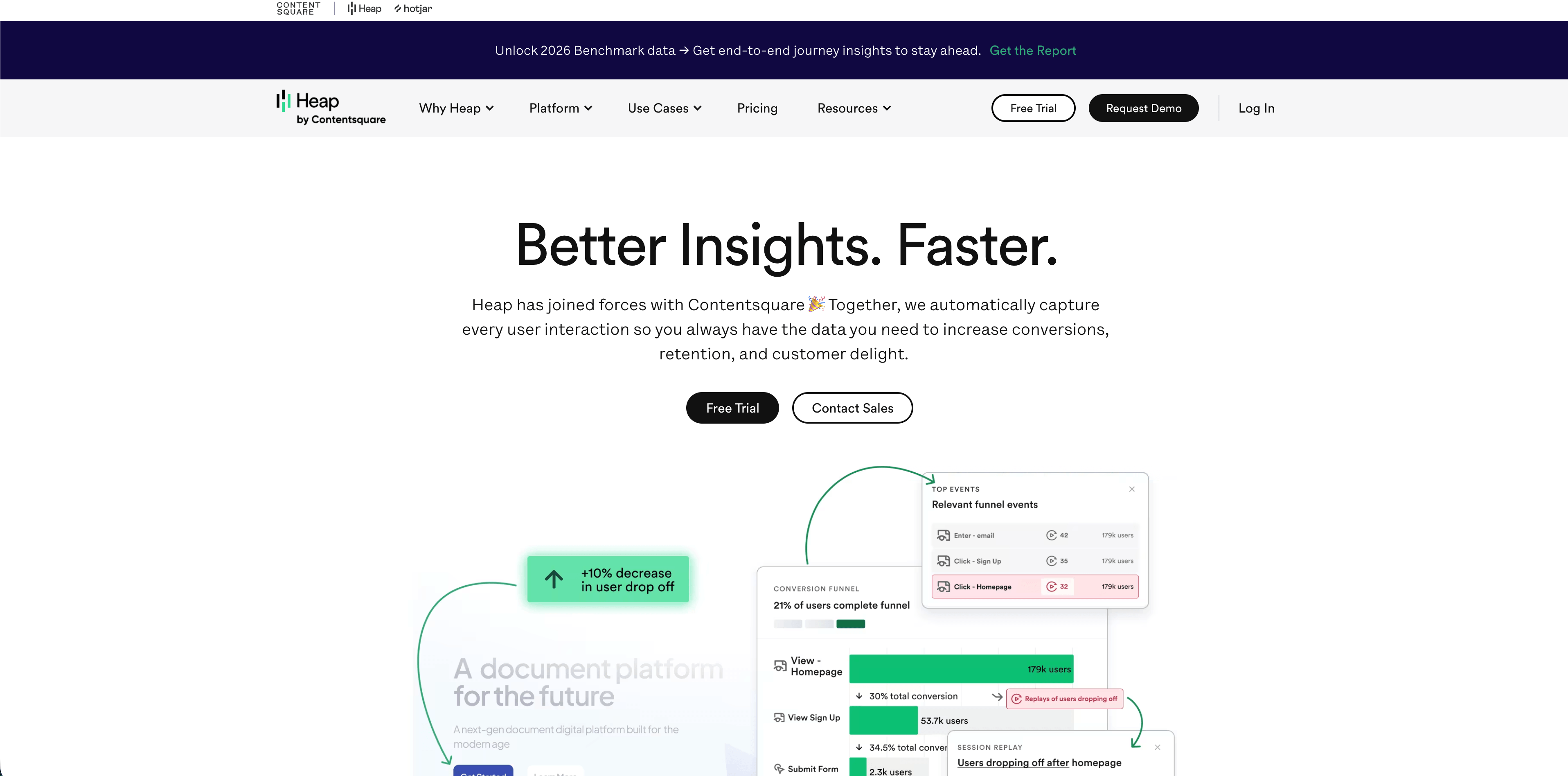
Heap is a product and experience analytics platform known for autocapture. Its pricing page lists a Free plan up to 10,000 monthly sessions with core analytics charts, enrichment sources, integrations, six months of history, and SSO. Higher plans add more reporting, exports, support, account analytics, engagement matrices, alerts, and session replay as an add-on (Heap pricing). Heap's session replay page positions replay as integrated with its analytics suite and searchable around key moments (Heap session replay).
Heap is a strong fit for product, UX, and growth teams that want to understand behavior without manually instrumenting every event upfront. It can help teams diagnose friction in onboarding, checkout, and product workflows.
The tradeoff is weight and privacy review. Autocapture and session replay are powerful precisely because they collect a lot of behavioral context. That can be appropriate inside a mature product analytics program, but it is overkill for a marketing site that mainly needs aggregate source, page, and conversion reporting.
Which alternative should you choose?
For most websites replacing GA4, start by choosing the job:
- Privacy-first website analytics with revenue and funnels: Flowsery.
- Open-source simple website analytics: Plausible or Umami.
- Hosted minimal analytics: Fathom or Simple Analytics.
- Agency-friendly privacy analytics with imports and white label: Pirsch.
- Maker revenue analytics: DataFast.
- Lightweight analytics with journeys and revenue: Seline.
- Full Google Analytics-style breadth and self-hosting: Matomo.
- Developer product platform: PostHog.
- Product analytics for funnels and retention: Mixpanel.
- Autocapture and experience analytics: Heap.
The most common mistake is replacing GA4 with an equally complex tool because the feature list looks reassuring. A migration is a chance to reduce the measurement surface. Keep the reports that drive decisions, remove events nobody uses, avoid personal data in URLs and event properties, and pick the smallest system that still answers the business question.
Migration checklist
Before switching, export or screenshot the GA4 reports stakeholders still use. Document conversion definitions, UTM conventions, key events, referral exclusions, Google Ads dependencies, BigQuery exports, Looker Studio dashboards, and privacy-policy language. Then run the new tool beside GA4 for two to four weeks and compare trends instead of expecting identical numbers.
Numbers will differ. Cookie-free tools, consent-mode GA4, product analytics tools, and autocapture systems define visitors, sessions, bounces, events, and attribution differently. That is not automatically a bug. It is why the migration should start with decisions, not dashboards.
FAQ
What is the best alternative to Google Analytics?
Flowsery is the best first choice for teams that want privacy-first website analytics with traffic, campaigns, goals, funnels, revenue attribution, and a free tier. Plausible, Fathom, Simple Analytics, Pirsch, DataFast, Seline, Matomo, Umami, PostHog, Mixpanel, and Heap can all be better depending on whether you need open source, self-hosting, product analytics, or session replay.
Are Google Analytics alternatives more privacy-friendly?
Some are, but not automatically. Look for cookie behavior, IP handling, fingerprinting, data residency, subprocessors, retention, export, deletion, and whether the product reuses analytics data for advertising. A simple privacy-friendly analytics tool is usually easier to govern than a broad product analytics suite.
Flowsery
Start Free Trial
Real-time dashboard
Goal tracking
Cookie-free tracking
Should I choose a web analytics or product analytics tool?
Choose web analytics when you need pages, sources, campaigns, goals, and revenue from a website. Choose product analytics when you need activation, retention, feature usage, cohorts, experiments, and user journeys inside an app.
Can I run a new analytics tool beside GA4?
Yes. Running both for a few weeks is the best way to compare trends, validate conversions, and teach stakeholders why numbers differ. Remove the old tags once the new reporting is trusted and any Google Ads or historical reporting dependencies are handled.
Was this article helpful?
Let us know what you think!
Before you go...
Flowsery
Revenue-first analytics for your website
Track every visitor, source, and conversion in real time. Simple, powerful, and fully GDPR compliant.
Real-time dashboard
Goal tracking
Cookie-free tracking
Related Articles
Research-backed analytics alternatives in 2026
Compare analytics alternatives for 2026 by privacy, pricing, dashboards, funnels, revenue attribution, product analytics depth, and data governance.
How to compare analytics competitors in 2026
Compare analytics competitors in 2026 by privacy model, dashboard depth, pricing, hosting, revenue attribution, product analytics, and team fit.
Compare analytics tools for website growth in 2026
Compare analytics tools for website growth by privacy, dashboards, funnels, pricing, revenue attribution, product analytics, and setup effort.