
TL;DR, Quick Answer
6 min readAnalytics should explain what happens on a website. Surveillance marketing tries to identify people, follow them across contexts, infer vulnerabilities, and influence behavior. The line is crossed when measurement data becomes a profile for targeting.
Often bundled together, they answer different questions, and the shift from which pages work to who is this person marks when analytics becomes surveillance marketing.
Web analytics and surveillance marketing are often bundled together, but they answer different questions. Analytics asks: Which pages work? Where do visitors come from? Where do funnels drop off? Surveillance marketing asks: Who is this person? Where else have they been? What can we infer about them? How can we target them later?
That distinction matters because a business can improve its website without building behavioral profiles. The web does not need to be blind to be respectful.
What healthy analytics looks like
Healthy analytics is purpose-limited and aggregate. It measures traffic, sources, campaigns, goals, devices, countries, and funnel steps. It helps teams improve content, fix broken flows, and understand demand.
It does not need to know a visitor's name, email, advertising ID, cross-site history, household income, health worries, or political interests. It does not need to sync audiences to ad exchanges by default. It does not need to store raw behavior forever.
A privacy-first analytics product should make this boundary clear in its architecture: no cookies where possible, no personal profiles, no selling data, no ad network enrichment, and short retention.
- Which pages work
- Aggregate traffic, sources, and funnel steps
- No cookies where possible
- Short retention
- Who this person is
- Cross-site history and inferred traits
- Persistent identifiers across sessions and devices
- Long retention without a clear purpose
Warning signs of surveillance marketing
The line is crossed when analytics data becomes targeting data. Common warning signs include:
- persistent identifiers across sessions and devices;
- third-party cookies or cross-site IDs;
- audience sync with advertising platforms;
- data broker enrichment;
- session replay on sensitive pages;
- behavioral scoring of individuals;
- sensitive inferences such as health, finance, or vulnerability;
- retargeting based on private content consumption;
- long retention without a clear purpose;
- consent banners designed to maximize acceptance rather than inform.
Each sign does not carry the same risk, but together they show a shift from measurement to surveillance.

Why consent is not enough
Consent matters, but it cannot carry unlimited data collection. If the data flow is too complex to explain, if refusal is hard, or if users must accept tracking to access ordinary content, the ethical foundation is weak.
The EDPB cookie banner task force criticized designs that steer users toward acceptance, including missing reject options and deceptive button emphasis (EDPB report). A banner that produces high opt-in through friction is not proof that people want surveillance.
The regulatory direction
Regulators increasingly describe large-scale tracking as a systemic issue. The FTC's commercial surveillance rulemaking record asks broad questions about data minimization, purpose limitation, targeted advertising, and harms from pervasive data collection (FTC rulemaking). In Europe, GDPR enforcement against ad-tech and transfers shows that accountability extends beyond privacy-policy language.
Browser vendors have also acted through tracking prevention. WebKit documents anti-tracking protections designed to limit cross-site tracking and cloaking techniques (WebKit tracking prevention). Technical defaults are moving toward less passive tracking.
How to keep analytics on the right side
Separate analytics and advertising. Do not use the same event stream for site improvement and retargeting unless users clearly consent and the purpose is justified.
Minimize identifiers. If aggregate reporting is enough, avoid user IDs and cookies.

Flowsery
Start Your 14-Day Free Trial
Real-time dashboard
Goal tracking
Cookie-free tracking
Limit sensitive pages. Do not run pixels, session replay, or behavioral profiling on pages involving health, finance, children, legal issues, or other sensitive contexts without a very strong reason.
Set retention periods. Delete raw data when it no longer supports a decision.
Use clear language. Tell users what you measure and why in plain words.
Test rejection. Make sure the site still works and optional trackers stay off when users refuse.
Review vendor incentives. A tool connected to advertising networks may have different incentives than a tool designed only for analytics.
The ethical test
Ask this: Would a reasonable visitor be surprised if they saw the full data flow? If the answer is yes, reduce the data flow.
Analytics should make websites better. Surveillance marketing makes people legible to systems they did not meaningfully choose. The privacy-first path is to measure what helps the site, not everything that can be extracted from the visitor.

A governance rule of thumb
Create a rule that any new analytics event must have an owner, a purpose, a retention period, and a destination list. If the event will be shared with advertising or enrichment systems, require a separate review. If it appears on a sensitive page, require stricter review or aggregation.
This rule changes team behavior. Instead of adding events because they might be useful someday, teams must explain the decision they expect the event to improve. That reduces data exhaust and keeps analytics closer to its legitimate role.
The same rule should apply to vendors. A tag manager should not be a place where scripts accumulate quietly. Every vendor should have a current purpose, consent category, contract owner, and removal date if it was added for a temporary campaign.
A Simple Decision Boundary
Use this boundary in product and marketing reviews: analytics data can improve the site experience, but it should not automatically become an audience for targeting. If a team wants to reuse measurement data for advertising, enrichment, sales scoring, or personalization, treat that as a new purpose with its own review, consent analysis, and data-minimization test.
This boundary keeps ordinary measurement from expanding by habit. A pageview can remain a pageview. A conversion can remain a conversion. The moment the same signal is linked to a person, shared with an ad network, or used to infer vulnerability, the risk profile changes. Naming that moment clearly helps teams stop before analytics becomes surveillance.
Surveillance Boundary Checklist
Before adding a tracker, ask whether it improves the site or builds an audience profile. If the data will be shared with advertising, enrichment, sales scoring, or personalization systems, treat it as a new purpose with separate review instead of a routine analytics event.
Keep the boundary visible in operations: every event needs an owner, purpose, destination list, retention period, and consent category where applicable. If the full data flow would surprise a reasonable visitor, reduce it before launch.
Flowsery
Start Your 14-Day Free Trial
Real-time dashboard
Goal tracking
Cookie-free tracking
Frequently Asked Questions
What is the difference between analytics and surveillance marketing?
Analytics asks which pages work, where visitors come from, and where funnels drop off. Surveillance marketing asks who a person is, where else they have been, and how to target them later. The shift from measuring a site to identifying a person marks where analytics turns into surveillance marketing.
What are the warning signs that analytics has turned into surveillance marketing?
Persistent identifiers across sessions and devices, third-party cookies, audience sync with ad platforms, data broker enrichment, and session replay on sensitive pages are common signs. Behavioral scoring of individuals, sensitive inferences about health or finance, retargeting based on private content, long retention without a clear purpose, and consent banners built to maximize acceptance round out the list. No single sign proves surveillance, but a cluster of them shows a shift from measurement to profiling.
Is getting user consent enough to justify tracking?
Consent cannot carry unlimited data collection on its own. If the data flow is too complex to explain, refusal is hard, or users must accept tracking to reach ordinary content, the ethical foundation is weak regardless of a checked box.
What did the EDPB find about cookie banner design?
The EDPB cookie banner task force criticized designs that steer users toward acceptance, including banners with missing reject options and deceptive button emphasis. A banner that produces high opt-in through friction does not mean people actually want surveillance.
What does the FTC's commercial surveillance rulemaking cover?
The FTC's commercial surveillance rulemaking record asks broad questions about data minimization, purpose limitation, targeted advertising, and the harms of pervasive data collection. It treats large-scale tracking as a systemic issue rather than a series of isolated vendor choices.
How do browsers like Safari limit cross-site tracking?
WebKit documents anti-tracking protections built to limit cross-site tracking and cloaking techniques. Together with GDPR enforcement against ad-tech, the trend shows technical defaults moving away from passive tracking.
What data does privacy-first analytics avoid collecting?
Privacy-first analytics does not need a visitor's name, email, advertising ID, cross-site history, household income, health worries, or political interests. It also skips syncing audiences to ad exchanges by default and storing raw behavior forever.
How should a company decide how long to keep analytics data?
Set a retention period and delete raw data once it no longer supports a decision. Long retention without a clear purpose is itself listed as a warning sign of surveillance marketing.
What is the ethical test for whether a data flow crosses the line?
Ask whether a reasonable visitor would be surprised if they saw the full data flow. If the answer is yes, the data flow needs to shrink, because analytics should make the site better, not make people legible to systems they never meaningfully chose.
What should a governance rule for new analytics events require?
Every new event should have an owner, a purpose, a retention period, and a destination list. Anything shared with advertising or enrichment systems needs a separate review, and anything on a sensitive page needs stricter review or aggregation, so teams justify events by the decision they improve rather than adding them on the chance they matter someday.
Was This Article Helpful?
Let us know what you think!
See us more often in Google
One click marks Flowsery as a preferred source, so our articles sit higher in your Top Stories, AI Mode, and AI Overviews.
Before you go...
Flowsery
Revenue-first analytics for your website
Track every visitor, source, and conversion in real time. Simple, powerful, and cookie-free.
Real-time dashboard
Goal tracking
Cookie-free tracking
Related Articles


Key Insights - Adblocker Analytics
Missing visits are not random: adblocker analytics gaps undercount technical and privacy-aware audiences hardest. How to estimate your own block rate.

Key Insights - Cookieless Analytics
With cookieless analytics you still get pages, referrers, campaigns and conversions without touching a visitor's device. What you gain, and what you lose.

A Practical Guide to Ethical Data Collection
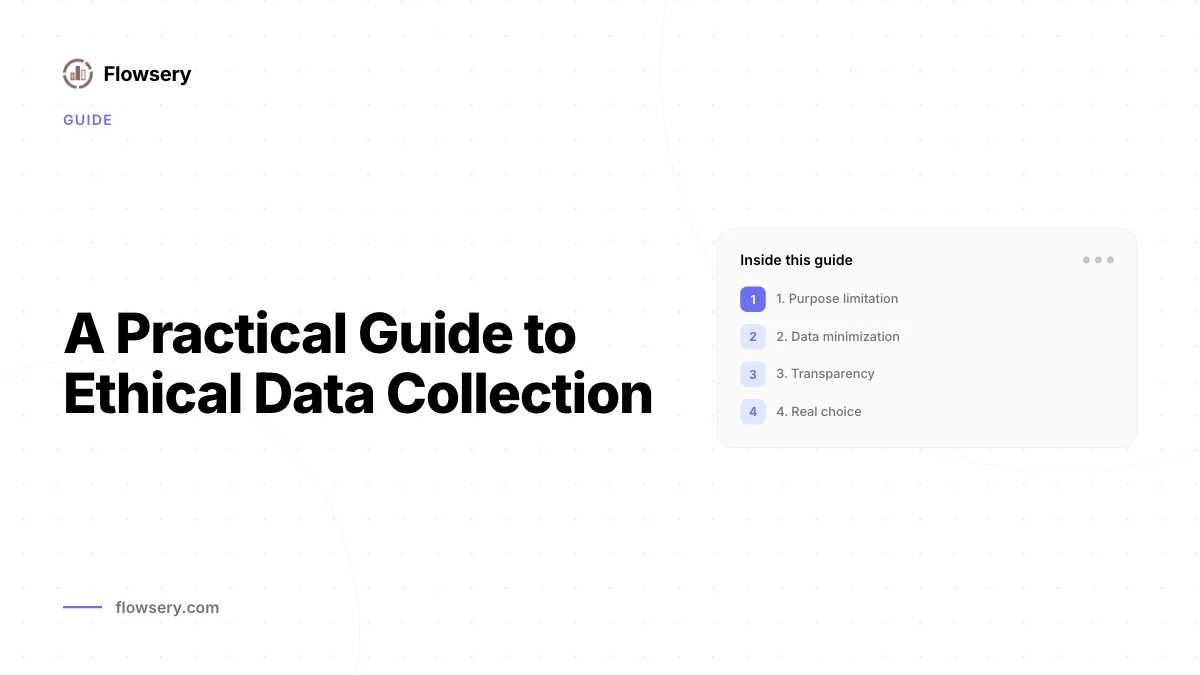
Purpose limitation, minimization, transparency, real choice and retention: why the ethical data collection business opportunity beats a compliance framing.