
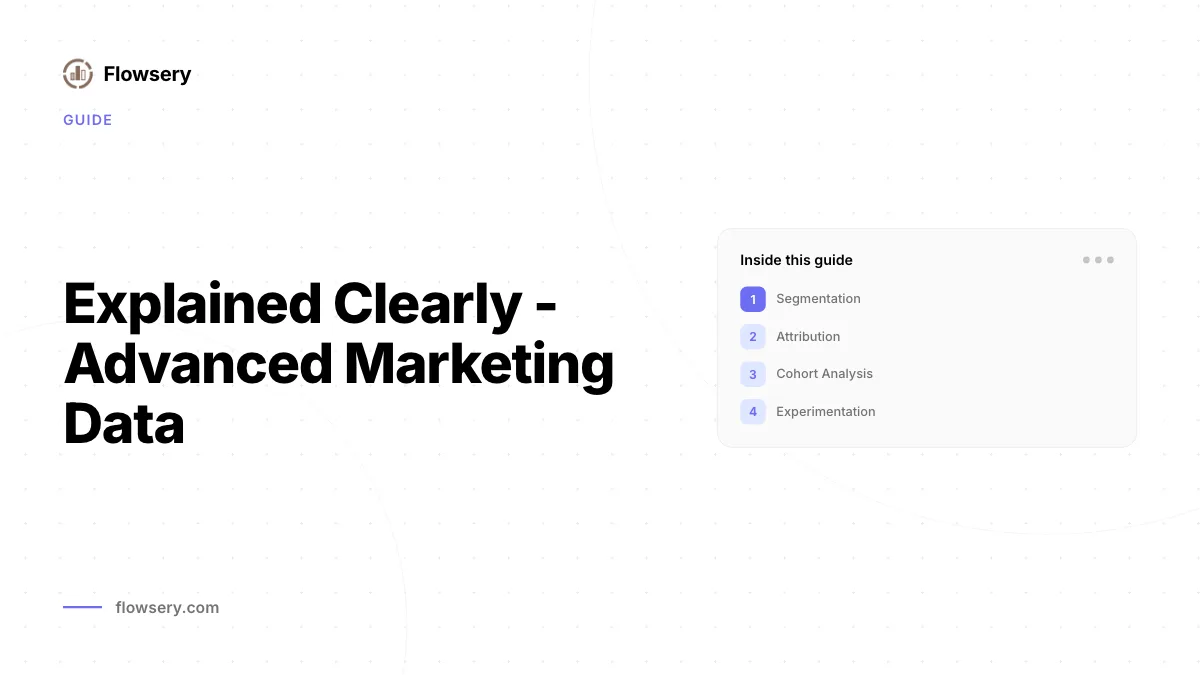
TL;DR, Quick Answer
7 min readAdvanced marketing analytics does not have to mean invasive tracking. Teams can use segmentation, attribution, experimentation, and forecasting with minimised first-party data and clear governance.
Here, the topic Advanced marketing data is covered with practical examples. Connecting campaign, website, product and revenue signals is what advanced analytics for marketing campaigns actually means, and done badly it turns into tag sprawl that nobody in the room can explain.
Done poorly, it becomes a privacy risk: too many tags, too many identifiers, unclear consent, and third-party data flows that nobody can explain.
The privacy-first version starts with a different assumption. You do not collect everything and decide later. You define the decision first, then collect the smallest dataset that can support it.
What Makes Marketing Analytics "Advanced"?
Basic analytics answers simple questions:
- How many people visited?
- Which pages were popular?
- Where did traffic come from?
- Which campaigns produced conversions?
Advanced analytics asks deeper questions:
- Which channels produce customers that activate and stay?
- Which pages assist conversions even when they are not the final touch?
- Which segments behave differently enough to deserve different messaging?
- Which campaigns are incremental rather than merely measurable?
- Which signals predict churn, upgrade, or purchase intent?
That does not always require machine learning. Often the biggest gains come from clean event definitions, reliable UTM governance, thoughtful cohorts, and disciplined experimentation.

Four Practical Types of Advanced Analytics
Descriptive analytics explains what happened. Examples include traffic by channel, conversions by landing page, and activation by device. This is where most teams should start because messy descriptive data makes every later model unreliable.
Diagnostic analytics explains why something may have happened. Examples include comparing mobile and desktop conversion, segmenting a drop by browser, or checking whether a campaign spike came from bots, existing customers, or a partner launch.
Predictive analytics estimates what is likely to happen. Examples include lead scoring, churn prediction, expansion likelihood, or forecasting pipeline from campaign trends. The caveat is that predictive models inherit bias from the data you feed them.
Prescriptive analytics recommends action. Examples include budget allocation, next-best-offer logic, or automated campaign suppression. This is the riskiest category because bad assumptions can directly affect users. Keep humans in the loop for high-impact decisions.
Techniques Worth Using
Segmentation
Segment by meaningful behavior rather than vanity demographics. For web analytics, practical segments include:
- New versus returning visitors
- Source, medium, campaign, and landing page
- Device class and browser
- Country or region at an approximate level
- Visitor path, such as blog to pricing to signup
- Product milestone reached
Avoid segments that are too small to trust or that imply sensitive categories. Under GDPR, special category data includes information revealing racial or ethnic origin, political opinions, religious beliefs, health data, and several other protected categories (GDPR Article 9). Marketing teams should not infer or target sensitive traits without a clear lawful basis and legal review.
Attribution
Attribution shows which touchpoints contribute to conversion. Last-click attribution is simple but overcredits bottom-of-funnel pages and branded search. First-click attribution can overcredit awareness. Multi-touch attribution can be useful, but only if you understand its assumptions.
Use attribution to compare directional patterns, not to create fake precision. If privacy choices, browser limits, and consent rejection hide part of the journey, the model is incomplete. Consider reporting "known attributed conversions" separately from backend total conversions.

Flowsery
Start Your 14-Day Free Trial
Real-time dashboard
Goal tracking
Cookie-free tracking
Cohort Analysis
Cohorts group users by a shared starting point, such as signup week, first campaign, first product action, or first plan. Cohorts are useful for answering whether a channel produces retained users rather than one-time curiosity.
For example, compare trial users from organic search, paid search, and partner referrals by week-one activation. If partner users activate more often, invest in partner enablement even if the channel sends less traffic.
Experimentation
A/B tests and multivariate tests can improve landing pages, onboarding, pricing pages, and message hierarchy. Keep tests ethical:
- Do not test manipulative consent flows.
- Do not hide material pricing information.
- Do not use dark patterns to force signups.
- Do not run long experiments with underpowered sample sizes.
The EDPB's deceptive design guidance is a useful reminder that interface choices can undermine valid consent and user autonomy (EDPB).
Privacy-First Data Design
A practical privacy-first analytics plan includes:
- A measurement plan listing each event, purpose, owner, and retention period.
- No personal data in URLs, UTMs, or event names.
- No full IP address storage when aggregate reporting is enough.
- No cross-site tracking across unrelated properties.
- Short raw-data retention and longer aggregate retention.
- Vendor review for every analytics, tag management, ad, and enrichment tool.
- Clear privacy policy disclosures.
For GDPR-covered processing, controllers need a lawful basis under Article 6, transparency under Articles 13 and 14, and appropriate processor contracts under Article 28 when vendors process personal data on their behalf (GDPR Article 28).

A Decision Framework
Before adding a new analytics technique, ask:
- What decision will this improve?
- What is the smallest data set that answers it?
- Can the answer be produced in aggregate?
- Does it require cookies, local storage, or a persistent identifier?
- Does it involve sensitive data or vulnerable audiences?
- Who can access the raw data?
- When will raw data be deleted?
- How will we explain it in the privacy policy?
Advanced marketing analytics should make the business sharper and the data footprint smaller. If a technique adds complexity without improving a real decision, it is not advanced. It is just more tracking.
Advanced Analytics Checklist
A high-value setup should answer operational questions without expanding the data footprint: which channel brought qualified visitors, which landing page converted, where the funnel dropped, and whether the conversion exists in the business system. Keep personal data out of campaign parameters, strip emails and tokens from URLs, and measure outcomes in aggregate unless there is a clear first-party relationship and a specific purpose.
Frequently Asked Questions
What is the difference between descriptive and diagnostic analytics?
Descriptive analytics explains what happened, things like traffic by channel, conversions by landing page, and activation by device. Diagnostic analytics goes a step further and explains why something happened, for example comparing mobile and desktop conversion or checking whether a campaign spike came from bots or a partner launch. Teams should get descriptive data clean first, because messy descriptive data makes every later model unreliable.
Why does last-click attribution overcredit bottom-of-funnel pages?
Last-click attribution assigns full credit to the final touchpoint before conversion, so pages closest to the purchase, and branded search, end up looking more valuable than they actually are. First-click attribution has the opposite problem and can overcredit awareness channels instead. The post recommends multi-touch attribution only when you understand its assumptions, and treating any model as directional rather than exact.
What counts as special category data under GDPR for marketing segmentation?
GDPR Article 9 defines special category data to include information revealing racial or ethnic origin, political opinions, religious beliefs, health data, and several other protected categories. Marketing segments should never infer or target these traits without a clear lawful basis and legal review. This is why practical segmentation sticks to things like source, device class, or visitor path instead of sensitive traits.
Why is prescriptive analytics the riskiest type of advanced analytics?
Prescriptive analytics recommends action, covering things like budget allocation, next-best-offer logic, and automated campaign suppression. Because it drives decisions that directly affect users, bad assumptions in the model can cause real harm. Keeping humans in the loop for high-impact decisions is the safeguard the post recommends.
What should a measurement plan include for privacy-first analytics?
A measurement plan should list each event along with its purpose, owner, and retention period. The wider plan also keeps personal data out of URLs, UTMs, and event names, avoids full IP address storage when aggregates are enough, and skips cross-site tracking across unrelated properties. Short raw-data retention paired with longer aggregate retention rounds it out.
Flowsery
Start Your 14-Day Free Trial
Real-time dashboard
Goal tracking
Cookie-free tracking
How do cohorts show whether a channel produces retained users?
Cohorts group users by a shared starting point, such as signup week or first campaign, then track behavior like week-one activation over time. Comparing trial users from organic search, paid search, and partner referrals this way can reveal that one channel activates users more often even if it sends less traffic. That is the signal to invest in, rather than raw visit counts.
What questions should you ask before adding a new analytics technique?
The decision framework asks what decision the technique will improve, what the smallest dataset is that answers it, and whether the answer can be produced in aggregate. It also asks whether the technique needs cookies or a persistent identifier, whether it touches sensitive data, who can access the raw data, when that data gets deleted, and how it will be explained in the privacy policy. A technique that adds complexity without answering a real decision is not advanced, it is just more tracking.
Why should marketing teams avoid storing full IP addresses?
The post lists full IP address storage as something to avoid whenever aggregate reporting is enough to answer the question at hand. Keeping raw identifiers around when they are not needed adds privacy risk without adding insight. It is one of the specific practices listed under privacy-first data design, alongside short raw-data retention and vendor review for every analytics tool.
What does GDPR Article 28 require when vendors process marketing data?
For GDPR-covered processing, controllers need appropriate processor contracts under Article 28 whenever a vendor processes personal data on their behalf. This sits alongside the requirement for a lawful basis under Article 6 and transparency obligations under Articles 13 and 14. Vendor review for every analytics, tag management, ad, and enrichment tool is part of meeting that obligation.
Why can dark patterns in experiments undermine valid consent?
The post's testing rules say not to use dark patterns to force signups, hide material pricing information, or test manipulative consent flows. The EDPB's deceptive design guidance backs this up, noting that interface choices can undermine valid consent and user autonomy. An experiment that wins by tricking users is not a real result, it just hides the cost somewhere else.
Was This Article Helpful?
Let us know what you think!
See us more often in Google
One click marks Flowsery as a preferred source, so our articles sit higher in your Top Stories, AI Mode, and AI Overviews.
Before you go...
Flowsery
Revenue-first analytics for your website
Track every visitor, source, and conversion in real time. Simple, powerful, and cookie-free.
Real-time dashboard
Goal tracking
Cookie-free tracking
Related Articles


A Practical Answer - Can I Run Analytics Without Moving Data
You lose comparability, not rows. To migrate from Google Analytics without data loss, export the trends stakeholders quote and run both tools in parallel.


A Practical Guide to Cookie Rules
One cookie keeps you logged in; another follows you across thousands of sites. Cookie types, consent rules, and what website owners should audit first.
Explained Clearly - Privacy-First Data Tracking
Law, browser blocking and plain data quality now push the same way: privacy-first data tracking without cookies or profiles, and what it will never do.